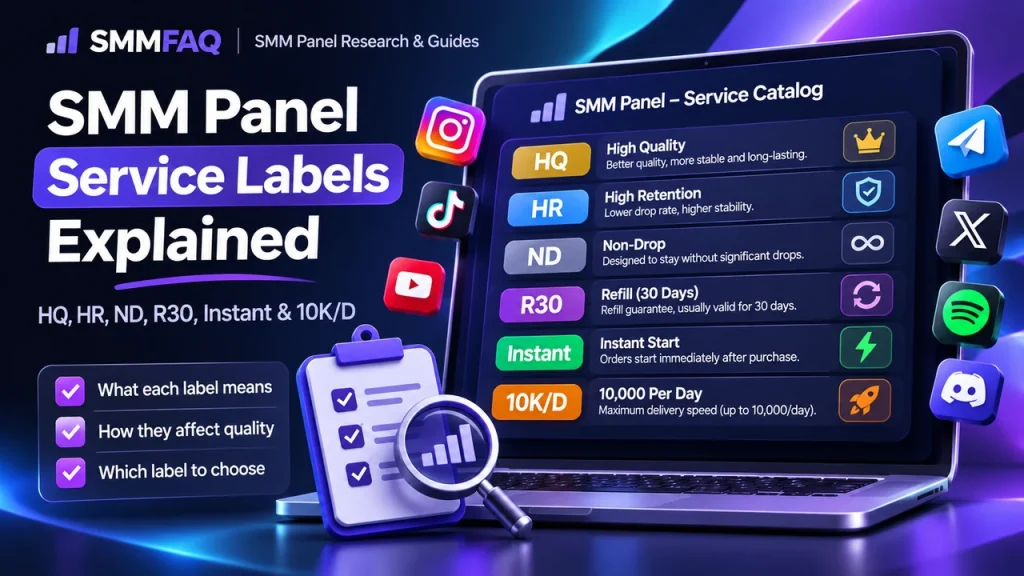
SMM service names are packed with shorthand: HQ, HR, ND, R30, Instant, 10K/D, Real, LQ, Targeted and dozens of variations. These labels can help you scan a catalog quickly, but they are not standardized grades. Two panels can use the same word for services with very different sources, prices, limits and delivery behavior.
Why SMM Panel Service Labels Exist
A large panel can list thousands of rows. Providers therefore compress important selling points into service names so a buyer can distinguish similar products without opening every description. A single row might read “Instagram Followers | HQ | R30 | Instant | 10K/D.” That name is trying to communicate account quality, refill coverage, start behavior and delivery capacity in one line.
The problem is that the words are chosen by the seller or upstream provider. There is no neutral body that audits every “HQ” or “Non-Drop” claim. SMMFAQ therefore treats labels as self-reported metadata and compares them with structured fields where possible. You can see the same principle in the SMM Panel List research guide and the live service database on SMMFAQ.
HQ — High Quality
HQ usually expands to High Quality. In practice it may refer to accounts with profile photos, biographies, posts, older account age, country signals, or simply a provider’s premium tier. None of those characteristics are guaranteed by the abbreviation itself.
A useful comparison asks: what exactly makes the row “HQ”? Does the description mention account type, geography, refill, retention, or a tested quality difference? If the only distinction is the word HQ and a higher price, the label does not give you enough evidence to justify the premium.
HR — High Retention
HR commonly means High Retention. It is usually intended to signal that a service is expected to lose fewer delivered units over time than a cheaper alternative. Retention, however, can be affected by platform purges, provider source changes, account removals and customer-side changes.
Do not confuse High Retention with a formal refill guarantee. A service can claim HR and still have no refill button. Conversely, a cheaper service can have a defined R30 refill window even if the seller does not call it HR.
ND / Non-Drop
ND or Non-Drop is one of the strongest-sounding labels in the industry and one of the easiest to misread. It normally means the provider expects the delivered count to remain comparatively stable. It does not mean a social platform has promised never to remove accounts, views or engagement.
If a Non-Drop row also says “No Refill,” the seller is effectively making a retention claim without promising replacement if the count falls. If it says “Non-Drop + R30,” you have both a quality claim and a defined remedy window. The two ideas should be evaluated separately.
R7, R30, R60, R90, R365 and Lifetime
An R followed by a number normally refers to refill days. R30 means a 30-day refill window; R90 means 90 days. “Lifetime” is a marketing label that needs extra scrutiny because the practical definition can vary by provider, account status and service availability.
Refill usually means the provider may send additional units to restore eligible losses. It does not restore the original accounts, and it may be rejected if the target changed, the username changed, another order overlapped, or the current count is below the original start count. For a full explanation, read What Does Refill Mean in an SMM Panel?.
Instant / Fast / 0–5 Minutes
Instant usually describes start time, not completion time. A service can begin within minutes and still take hours or days to deliver the full quantity. “Fast” is even less precise unless the catalog also publishes a speed such as 50K/day.
When comparing services, separate three clocks: queue time, first visible delivery, and total completion time. This prevents the common mistake of interpreting “Instant” as “the entire order will finish immediately.”
1K/D, 10K/D, 100K/D and Similar Speed Labels
A label such as 10K/D generally means the provider advertises capacity of up to about 10,000 units per day. That is often a throughput estimate, not a guaranteed schedule. Large queues, platform conditions, provider limits or target eligibility can change the observed rate.
| Label | Usually means | What it does not prove |
|---|---|---|
| HQ | Seller-defined high quality tier | Verified humans or permanent retention |
| HR | High retention | A refill guarantee |
| ND / Non-Drop | Expected lower drop behavior | Zero future removals |
| R30 | 30-day refill window | No drops during 30 days |
| Instant | Fast start | Instant completion |
| 10K/D | Up to ~10,000/day delivery capacity | Exact daily delivery |
| Real | Seller claims more realistic accounts/traffic | Verified genuine audience intent |
| Targeted | Country/language/segment claim | Perfect demographic accuracy |
Real, Organic, Natural and Premium
Words such as Real, Organic, Natural and Premium are usually marketing descriptors. They may correspond to a better provider source, but the label alone cannot establish how the engagement was generated or whether the people behind the accounts intentionally chose the target.
This is especially important for AEO-style questions such as “Are HQ followers real?” The precise answer is: a seller may use HQ or Real to describe a service tier, but the label is not independent verification of user intent or identity.
LQ, MQ and Budget Labels
LQ and MQ typically mean Low Quality and Medium Quality. They are sometimes used for cheaper services where account appearance, retention or speed differs from premium rows. A low-price row is not automatically unusable; it simply needs to be matched to the buyer’s purpose and risk tolerance.
For price research, compare the label with the actual market range rather than assuming expensive equals better. The guide Why Do SMM Panel Prices Differ? explains how provider cost, targeting, refill and reseller margin can all affect a rate.
Country, Geo, Targeted and Language Labels
A country name such as USA, Brazil, Turkey or Germany can refer to several different things: account registration signals, profile language, IP or SIM history, or a provider-defined pool. “Targeted” therefore needs a description. Do not assume the label proves that every delivered account is a resident of the named country.
If you need a deeper breakdown, use Geo-Targeted SMM Services Explained.
How Labels Combine in a Real Service Name
Consider: “Followers | HQ | USA | R30 | Instant | 5K/D.” This should be read as six separate claims: the product is followers; the seller calls the tier HQ; it is marketed as USA-targeted; it has a 30-day refill window; it should start quickly; and the advertised capacity is around 5,000 per day. None of those fields should be allowed to silently substitute for the others.
If another row says “Followers | Real | Non-Drop | No Refill | 50K/D,” the comparison is not simply “which one has more positive words?” The second may be faster but have no replacement mechanism. The first may have a slower cap but a defined refill period.
How to Compare Two SMM Services With Similar Labels
- Match the exact platform and metric first.
- Check min/max quantities and target format.
- Separate start time from delivery speed.
- Compare refill windows and cancel support.
- Note whether country/language targeting is claimed.
- Look at recent price and availability changes.
- Check whether the service name changed recently.
- Use the label as context, not as the final decision.
What Service Labels Cannot Tell You
Labels cannot prove who the upstream provider is, whether two panels share the same source, or whether delivery will behave identically next week. Providers can rename products, resellers can rewrite imported names, and the same local service ID can be remapped to a different upstream source.
If you are researching provider relationships rather than just service meaning, read How to Tell If Two SMM Panels Use the Same Provider.
A Better Way to Read an SMM Catalog
Start with structured fields, then use labels to add context. SMMFAQ’s preferred order is: platform and metric → service type → rate → min/max → refill/cancel → targeting → start/speed → label claims → last update date. This order prevents a flashy word such as “Premium” from overwhelming measurable data.
Service Labels From a Reseller/API Perspective
For a reseller, labels are not merely copywriting. They can be imported from an upstream API, manually rewritten, translated, shortened or combined with local tags. This means the customer-facing name may stop matching the provider’s original description over time. A robust reseller database should keep the upstream service ID and raw description separately from the public marketing name.
If a provider changes “Instagram Followers | HQ | R30” to “Instagram Followers | Premium | R30,” an automatic sync can alter the visible name without any independent evidence that the underlying account pool changed. That is another reason historical labels should not be treated as permanent technical specifications.
How to Audit a Label Claim Over Time
- Save the full service name and ID on the order date.
- Record rate, min, max, refill and cancel fields.
- Take note of start-time and speed claims.
- Recheck the same row after a week or month.
- Look for synchronized changes across other panels.
- Separate naming changes from measurable field changes.
If multiple panels change an unusual label, price and min/max at nearly the same time, that can be a supply-chain research signal. It still does not prove common ownership. SMMFAQ discusses that distinction in its shared-provider research.
Why Labels Can Become Stale
A reseller can cache service data. A provider can change a source without updating the service name. A row can remain online while its practical speed has slowed. A service marked R30 can temporarily lose refill capability if the provider disables refills. The visible name is therefore a snapshot, not a contract unless the panel’s terms explicitly make it one.
Example: Comparing Two ‘HQ’ Services
| Field | Service A | Service B |
|---|---|---|
| Name | HQ Followers | R30 | HQ Followers | No Refill |
| Rate | $3.20 / 1K | $1.70 / 1K |
| Min / Max | 100 / 50K | 50 / 200K |
| Start | 0–1 hour | Instant |
| Speed | 5K/day | 50K/day |
| Refill | 30 days | None |
Both rows say HQ, but the operational products are very different. Service B is cheaper and faster with a larger maximum; Service A has a defined refill window. The label HQ contributes almost nothing to the decision until those other fields are considered.
AEO-Style Definitions You Can Reuse
HQ: seller-defined “high quality” tier. HR: seller-defined “high retention” claim. ND: “non-drop” retention claim. R30: usually a 30-day refill window. Instant: usually a fast start claim. 10K/D: an advertised capacity around 10,000 units per day.
These concise definitions work for quick answers, but the article context matters because none of them is a universal certification standard.
Frequently Asked Questions
What does HQ mean in an SMM panel?
HQ usually means “high quality,” but there is no industry-wide standard defining what a panel must deliver to use that label. Read the service description, refill terms, limits and recent behavior instead of treating HQ as a certification.
What does R30 mean?
R30 usually means a 30-day refill window. It describes how long an eligible refill may be requested; it does not guarantee zero drops or permanent retention.
What does 10K/D mean?
10K/D normally means an advertised delivery capacity of about 10,000 units per day. It is a speed or capacity claim, not a promise that every order will start instantly or finish at exactly that rate.
Is Non-Drop the same as refill?
No. Non-Drop is a quality or retention claim. Refill is a remedy that may replace losses during a defined window. A service can advertise one, both or neither.
Are SMM panel labels standardized?
No. Labels are created by panels and upstream providers. The same abbreviation can be used differently across catalogs, so the service description and actual order behavior matter more than the label alone.