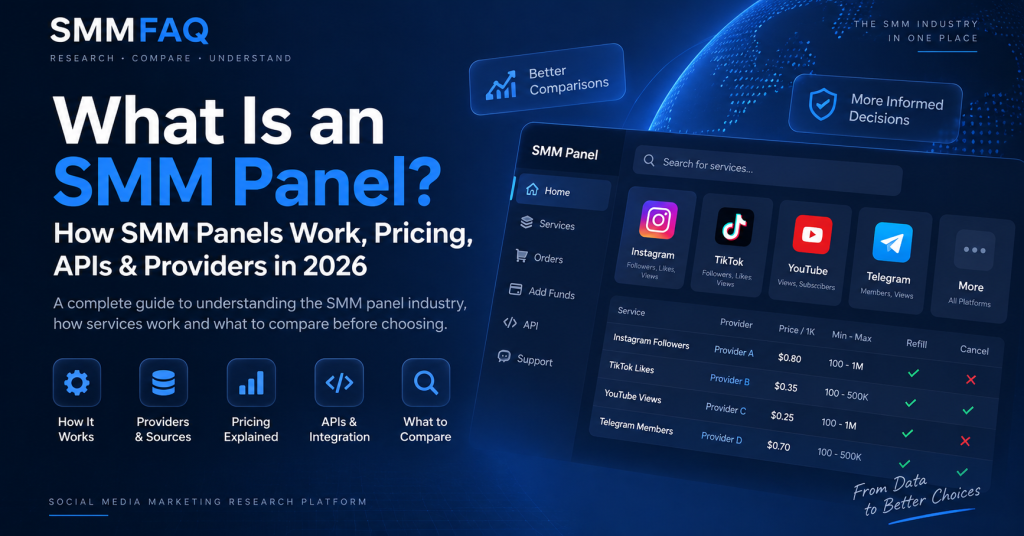
An SMM panel is an online platform that provides access to social media marketing services such as followers, likes, views, subscribers, reactions, members and other engagement-related services.
The important thing to understand is that an SMM panel is not always the original source of every service it sells.
The industry contains multiple layers. Some panels operate their own infrastructure or maintain direct relationships with service sources, while others purchase services through another provider’s API and resell them.
That is why two different SMM panels can sometimes offer very similar services at very different prices.
In this guide, we will explain how SMM panels work, where their services come from, how pricing is determined, what an SMM panel API does and what users should compare beyond price.
What Is an SMM Panel?
SMM stands for Social Media Marketing.
An SMM panel is essentially a service marketplace designed to make social media services easier to browse and order.
A typical panel may contain thousands of services for platforms such as:
- TikTok
- YouTube
- Telegram
- X
- Spotify
- Twitch
- Discord
Each service normally includes information such as its price, minimum quantity, maximum quantity, estimated behavior and whether features such as refill or cancellation are supported.
For example, an Instagram category may contain multiple follower services with different prices, delivery speeds, refill periods and account characteristics.
This is why looking only at the cheapest rate rarely gives the full picture.
How Does an SMM Panel Work?
From the customer’s perspective, the process is relatively simple.
A user creates an account, adds funds, selects a service and submits a social media link or username.
Behind the interface, however, several different systems may be involved.
A simplified order flow can look like this:
Customer → SMM Panel → Provider API → Service Source → Social Platform
When an order is created, the panel records the order information and may either process it internally or send it automatically to an upstream provider through an API.
The upstream provider then processes the order and returns status information to the reseller panel.
This process can happen automatically without the customer ever knowing which provider is behind the service.
Where Do SMM Panels Get Their Services?
There is no single source used by every SMM panel.
Different panels may obtain services in different ways.
Some maintain direct connections with service operators or networks.
Others purchase services from larger SMM providers.
Many panels use several different providers at the same time.
A single panel could therefore use one provider for Instagram followers, another for YouTube views and another for Telegram members.
Large panels may also switch providers when a service becomes unstable, expensive or unavailable.
This is one reason why service quality can change over time even when the service ID or description appears similar.
What Is an SMM Panel Provider?
An SMM panel provider is a company or platform that supplies services to customers, resellers or other panels.
However, the word “provider” can be used loosely in the SMM industry.
A provider may be:
- a direct service source
- a large reseller
- an API supplier
- or a panel that combines services from several upstream sources.
Because of this, claims such as “main provider” or “direct provider” should not automatically be treated as proof that a company operates the original source.
The provider chain may contain several layers.
For example:
Source → Primary Distributor → API Provider → Reseller Panel → Customer
In other situations, the chain may be much shorter.
Understanding these layers is useful when comparing prices and service behavior.
You can explore provider profiles in the SMMFAQ Providers section.
What Does “Main Provider” Mean?
The phrase main provider is frequently used by SMM panels, but it does not have a universal technical definition.
Different companies may use the term differently.
Some use it to describe direct access to a service source.
Others use it to describe a large wholesaler.
Others may simply use it as marketing terminology.
For researchers and buyers, the more useful questions are:
- Who appears to supply the service?
- How frequently is the catalog updated?
- Is the service available through API?
- Does the provider clearly disclose refill and cancellation rules?
- How stable is the service over time?
These details are often more useful than a label such as “main provider.”
How SMM Panel Pricing Works
Most SMM panel services are displayed using a price per 1,000 units.
For example, a service listed at:
$0.80 per 1,000
would normally cost approximately $8.00 for 10,000 units, assuming the service uses standard proportional pricing.
However, the listed rate can vary significantly between panels.
Several factors influence SMM service prices.
Upstream Provider Cost
If a reseller purchases a service for $0.50 per 1,000, it may resell the same service for $0.60, $0.80 or more.
The difference becomes the reseller’s margin.
Number of Reseller Layers
A service may pass through several panels before reaching the final customer.
Each layer can add a markup.
This means two services that ultimately use the same source may have different retail prices.
Service Quality and Characteristics
Not every follower, view or member service behaves the same way.
Different services may vary in:
- retention
- delivery speed
- country targeting
- account quality
- refill protection
- maximum quantity
- and cancellation availability.
A more expensive service may therefore offer different characteristics rather than simply being an overpriced version of a cheaper service.
Currency Conversion
International panels operate using different currencies.
USD, EUR, TRY, INR and cryptocurrencies may all be used.
Exchange-rate differences can affect displayed prices.
Provider Changes
Panels can change upstream providers without changing the visible category structure.
When this happens, pricing may increase or decrease.
For this reason, historical pricing should not automatically be treated as current pricing.
SMMFAQ service comparison pages are designed around recently synchronized provider data so users can compare current catalog information more easily.
Why Can the Same SMM Service Have Different Prices?
This is one of the most common questions in the industry.
There are several possible explanations.
Two panels may be reselling the same upstream service but using different profit margins.
One panel may have direct access to a supplier while another buys through an intermediary.
The services may also look similar while actually coming from different sources.
For example, two services may both be called:
Instagram Followers – Refill
but one may provide a 30-day refill period while another provides 90 days.
Their delivery speeds or account sources may also differ.
Service names alone therefore do not prove that two services are identical.
What Is an SMM Panel API?
An SMM panel API allows another application or panel to interact with an SMM provider automatically.
Many panels use a similar API structure.
A reseller can use the API to retrieve available services, submit orders and check order status.
Common API actions include:
- services — returns the service catalog
- add — creates a new order
- status — checks an order
- refill — submits a refill request
- cancel — requests cancellation when supported
- balance — returns the account balance
A typical service API response may contain information such as:
Service ID
Service name
Category
Rate
Minimum order
Maximum order
Refill availability
Cancel availability
This allows reseller panels to synchronize thousands of services automatically instead of updating them manually.
You can learn more in the SMMFAQ SMM APIs section.
Why Do SMM Panels Use APIs?
APIs make it possible for panels to automate large catalogs.
Without APIs, a reseller would need to manually forward each order to its provider.
With API integration, orders can be transmitted automatically within seconds.
APIs also allow panels to update prices and service availability more efficiently.
For example, if a provider changes the rate of a service, the reseller can retrieve the latest service catalog and update its own pricing.
This automation is a major reason why modern SMM panels can list thousands of services.
Main Provider vs Reseller Panel
The difference between a provider and a reseller is not always obvious from the website.
A reseller can have a very professional platform, thousands of services and competitive prices.
Similarly, a provider may still use external sources for parts of its catalog.
Rather than trying to classify every panel using a single label, it is often more useful to evaluate each service individually.
Important factors include:
- price
- minimum and maximum quantity
- refill period
- cancellation support
- service history
- delivery behavior
- last update date
- provider information
SMMFAQ focuses on comparing this type of structured service information rather than relying only on promotional claims.
What Is Refill?
Refill is a feature offered by some services.
If delivered followers, members or another count decrease during the stated guarantee period, the customer may be able to request a refill.
Common refill periods include:
- 7 days
- 30 days
- 60 days
- 90 days
- 365 days
- or lifetime.
However, refill rules differ by provider.
Some services automatically refill drops.
Others require the customer to submit a request.
Certain conditions may also invalidate a refill, such as changing a username, making an account private or ordering additional services for the same link.
The exact provider terms should always be checked before ordering.
What Does Cancel Mean?
Some SMM panel services include cancellation support.
A cancellable service may allow an unfinished order to be stopped under certain conditions.
This does not necessarily mean every active order can be cancelled immediately.
The provider determines whether cancellation is available and when it can be processed.
Services that support cancellation are often identified in API catalogs using a field such as:
cancel: trueServices without this feature may continue processing until completion or until the provider changes their status.
Minimum and Maximum Order Limits
Most services include minimum and maximum quantities.
For example:
Minimum: 100
Maximum: 100,000
These values define the quantity range accepted by the provider.
Trying to place an order below the minimum or above the maximum may cause the request to fail.
Maximum limits can also change depending on provider capacity.
For this reason, synchronized service data is useful when comparing large orders.
Why Delivery Speed Matters
Price is only one part of an SMM service.
Delivery speed can also be important.
Some services begin almost immediately.
Others may take several minutes or hours to start.
Large orders may also take significantly longer to complete.
A service with a slightly higher rate but more predictable delivery may be more suitable for some users than the cheapest available option.
At the same time, extremely fast delivery is not automatically better.
The appropriate speed depends on the service type and use case.
What Should You Compare Besides Price?
When comparing SMM services, consider the complete service profile.
Price should be evaluated together with:
- Refill: Is there a guarantee period?
- Cancel: Can unfinished orders be cancelled?
- Min/Max: Does the service support the quantity you need?
- Platform: Is the service designed for the correct social network?
- Targeting: Is country or audience targeting available?
- Delivery: How quickly does the service normally start?
- Provider: Where does the service appear to come from?
- Update Date: Is the information current?
A service that looks cheapest at first may not necessarily offer the best conditions for a particular order.
How SMMFAQ Compares SMM Panel Services
SMMFAQ is designed as an independent information and research platform for the global SMM panel market.
Instead of querying every provider live whenever a visitor performs a search, provider service catalogs can be periodically synchronized into the SMMFAQ database.
This allows searches to be performed locally and quickly.
Service information can include:
- provider
- service name
- category
- price per 1,000
- minimum quantity
- maximum quantity
- refill availability
- cancellation availability
- and last update information.
Users can then search services such as Instagram followers, TikTok likes, YouTube views or Telegram members and compare available catalog information.
Because provider catalogs change frequently, recently updated information should always be preferred.
Explore the dedicated service research sections for Instagram, TikTok, YouTube and Telegram.
Are All SMM Panels the Same?
No.
Panels can differ significantly in how they operate.
Some focus on low-cost services.
Some focus on reseller APIs.
Others specialize in particular platforms or geographic markets.
The number of services listed on a panel also does not necessarily indicate the number of unique underlying sources.
Thousands of services may come from multiple upstream providers or may include different variations of similar products.
This is why provider research and service-level comparison are both useful.
Final Thoughts
An SMM panel is more than a website that lists followers, likes and views.
Behind the visible catalog may be a network of providers, resellers, APIs and service sources.
Understanding how these layers work makes it easier to interpret price differences, refill rules, API catalogs and provider claims.
The most useful approach is to compare individual services using current data rather than assuming that the cheapest panel, largest catalog or “main provider” label automatically represents the best option.
SMMFAQ will continue organizing provider information, API data and service catalogs so users can research these differences more easily.
Frequently Asked Questions
What does SMM panel mean?
SMM panel stands for Social Media Marketing panel. It is an online platform that provides access to social media marketing services such as followers, views, likes, members and other forms of engagement.
Where do SMM panels buy their services?
Some panels use direct service sources, while others purchase services from larger providers through API integrations. Many panels combine several providers.
What is an SMM panel API?
An SMM panel API allows reseller panels or applications to retrieve services, submit orders, check order status and perform other supported actions automatically.
Are cheaper SMM panel services always the same?
No. Similar service names may have different sources, refill periods, delivery speeds, limits and account characteristics.
What is refill in an SMM panel?
Refill is a guarantee feature available on some services. If the delivered quantity decreases during the supported period, the provider may restore some or all of the lost quantity according to its rules.
What is a main SMM provider?
There is no universal industry definition. The term may refer to a direct source, wholesaler or large API supplier depending on how a company uses it.
How often do SMM panel prices change?
Prices can change frequently because upstream provider rates, currencies, supply and service availability can all change. Current synchronized pricing should be preferred over old screenshots or historical listings.