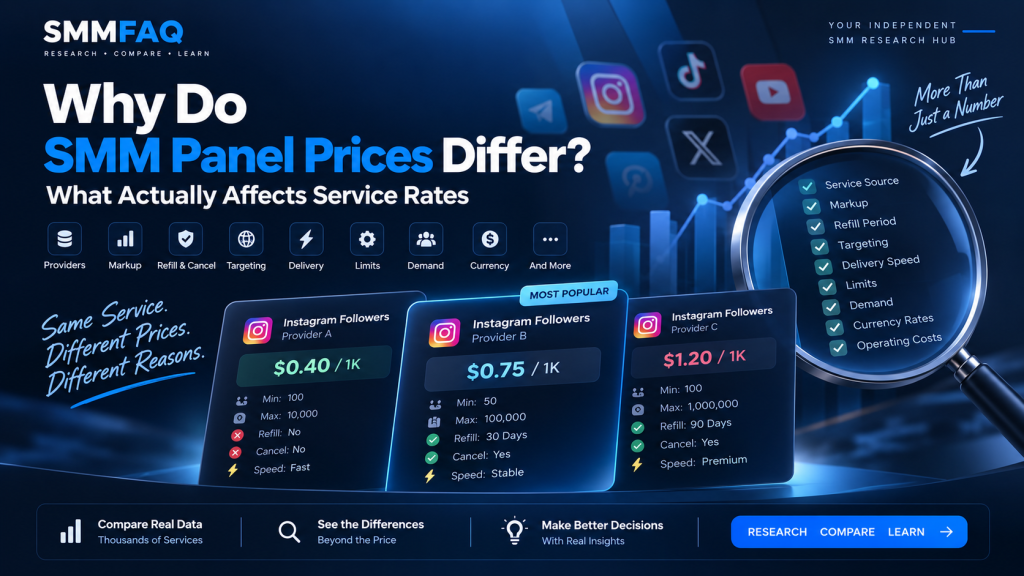
Two SMM panels can list what appears to be the same service at very different prices.
One panel may offer an Instagram followers service for $0.40 per 1,000, while another lists a similar service for $1.20 per 1,000.
At first glance, the obvious question is:
Why is one service three times more expensive?
There is rarely one simple answer.
SMM panel pricing can be affected by the service source, reseller markup, refill conditions, delivery characteristics, minimum and maximum limits, geographic targeting, supplier agreements, currency conversion, demand, and the number of businesses involved in the supply chain.
A lower price does not automatically mean a service is worse.
A higher price does not automatically mean it is better.
To understand SMM pricing properly, it helps to look at the individual fields behind each service rather than comparing only the number shown in the rate column.
If you are new to this industry, you may first want to read What Is an SMM Panel? and What Is an SMM Panel Provider?.
How Are SMM Panel Services Priced?
Most SMM services are displayed using a rate per 1,000 units.
For example:
Instagram Followers
Rate: $0.80 / 1,000
This is commonly shortened to:
$0.80 / 1KIf the service allows proportional ordering, an order for 500 units would generally correspond to approximately half the 1K rate.
Example:
Rate per 1K: $0.80
Quantity: 500
Estimated base cost: $0.40
The exact calculation may depend on the panel software, minimum quantity and rounding rules.
The important point is that the displayed rate is usually a normalized unit price.
It does not tell you everything about the service.
Why Can the Same Type of Service Have Different Prices?
Because the words used in the service name are not standardized.
Two services may both be called:
Instagram Followers
but differ in:
- source,
- targeting,
- delivery speed,
- refill period,
- account type,
- maximum quantity,
- cancellation support,
- geographic origin,
- retention characteristics,
- order processing method,
- or upstream provider.
So two similarly named services should not automatically be treated as identical products.
This is one of the main reasons price-only comparisons can be misleading.
1. The Upstream Service Source Affects the Price
One of the biggest factors is where the service comes from.
Consider two panels.
Panel A may buy a service directly from an upstream provider.
Panel B may buy the same service through another reseller.
The supply chain could look like this:
Service Source
↓
Provider
↓
Panel A
while another route could be:
Service Source
↓
Provider
↓
Reseller
↓
Panel B
Every additional business in the chain may apply its own markup.
As a result, the final customer price can increase even if the underlying service is similar.
This is one reason researching provider relationships can be useful.
You can read more about this structure in our guide to SMM panel providers.
2. Reseller Markup Can Be Very Different
Panels decide their own selling prices.
Suppose an upstream service costs:
$0.50 / 1KPanel A applies a 10% markup:
$0.55 / 1KPanel B applies a 50% markup:
$0.75 / 1KPanel C applies a 100% markup:
$1.00 / 1KAll three could potentially be connected to the same upstream service.
This means the price difference may come from the seller rather than the service itself.
Panels may choose different margins based on their operating costs, customer type, support model, payment costs or pricing strategy.
3. A Panel Can Use Different Providers for Similar Services
One panel may use Provider A for Instagram followers while another uses Provider B.
Even within the same panel, several similar services can come from different upstream providers.
For example:
| Service | Provider Rate |
|---|---|
| Instagram Followers A | $0.38 |
| Instagram Followers B | $0.62 |
| Instagram Followers C | $1.10 |
They all belong to the same broad category but may have different service characteristics.
That is why comparing only the platform and service type is not enough.
4. Refill Coverage Can Influence Pricing
A service with refill support may cost more than one without it.
For example:
Service A
$0.45 / 1K
No refill
and:
Service B
$0.70 / 1K
30-day refill
The higher-priced service may include a different replacement policy.
Some providers offer:
- no refill,
- 7-day refill,
- 15-day refill,
- 30-day refill,
- 60-day refill,
- 90-day refill,
- or another stated period.
However, refill length alone still does not determine service quality.
Providers can have different eligibility rules and refill processes.
A refill label should therefore be treated as one comparison field rather than a guarantee of future performance.
5. Cancel Support Can Change the Service Structure
Some services allow eligible orders to be submitted for cancellation.
Others do not.
A cancel-enabled service can be operationally different from a service that runs until completion without a cancellation option.
This can influence how providers build and price the service.
SMMFAQ shows Cancel as a separate field because it can be important when comparing similar listings.
6. Minimum and Maximum Limits Matter
A cheap service may have a relatively low maximum order quantity.
Another may allow much larger orders.
For example:
Service A
Price: $0.40
Min: 100
Max: 10,000
Service B
Price: $0.65
Min: 100
Max: 1,000,000The rate alone does not show this difference.
For customers who need larger quantities, the maximum limit can be as important as the price.
Minimum limits can also affect whether a service is practical for small test orders.
7. Geographic Targeting Can Affect Rates
Some services are marketed around specific countries or regions.
Examples could include:
- USA followers,
- Brazilian followers,
- Turkish followers,
- Indian followers,
- European traffic,
- Arabic audiences.
Targeted services can have different supply conditions from global or mixed-source services.
That may result in different rates.
However, geographic wording in a service name should not automatically be interpreted as independent proof of the exact origin of every account or interaction.
The provider’s current description and terms should still be reviewed.
8. Delivery Characteristics Can Affect Pricing
Services may differ in how they are designed to start and deliver.
Providers sometimes distinguish between services using terms such as:
- instant start,
- gradual delivery,
- fast,
- slow,
- stable,
- drip feed,
- premium,
- HQ,
- real-looking,
- or mixed.
These labels are not standardized across the industry.
“Fast” on one panel may not mean the same thing as “fast” on another.
Nevertheless, operational differences between services can influence provider costs and therefore the final price.
9. Demand and Capacity Can Change Prices
SMM service pricing is not necessarily permanent.
A provider may increase prices when:
- supply becomes limited,
- demand rises,
- service capacity falls,
- platform conditions change,
- fulfillment becomes more difficult,
- or an upstream supplier changes its own rate.
Prices can also fall when new supply becomes available or providers compete more aggressively.
This is why an SMM service price from several months ago may no longer represent the current market.
10. Provider Rates Can Change Automatically
Panels connected through an SMM API can synchronize upstream service information.
If the provider changes the rate, the reseller may detect that change automatically.
Example:
Old provider rate:
$0.55 / 1K

New provider rate:
$0.72 / 1K
A reseller panel may then:
- increase its selling price automatically,
- preserve the existing retail rate,
- calculate a new markup,
- or wait for manual review.
So even panels using the same provider can react differently to the same upstream price change.
11. Currency Conversion Can Create Price Differences
Not every panel operates in the same currency.
A provider might price its catalog in USD while a reseller displays services in EUR, TRY or another currency.
Exchange-rate conversion can affect the final displayed price.
Panels may also update their exchange rates at different times.
That means two websites can temporarily display different equivalent prices even if their original USD costs are similar.
Is the Cheapest SMM Panel Always the Direct Provider?
No.
This is a common assumption, but the price alone cannot establish the supply-chain position of a panel.
A reseller can sometimes sell a service very cheaply because it has:
- a low markup,
- negotiated pricing,
- volume discounts,
- temporary promotions,
- favorable currency conversion,
- or another provider with a lower cost.
Likewise, an upstream provider could choose to maintain a larger profit margin.
Therefore:
Cheapest price does not automatically mean closest to the original service source.
Price research and provider-source research are related, but they are not the same question.
Is the Most Expensive Service Better?
Not automatically.
A higher price may represent:
- different refill coverage,
- a different provider,
- a different target market,
- higher markup,
- greater limits,
- different delivery characteristics,
- or simply a more expensive seller.
Without additional information, price alone cannot determine overall service quality.
This is why SMMFAQ does not treat the highest or lowest rate as an overall quality score.
Why Do Identical-Looking Services Sometimes Have Different Prices?
Because the service names may hide important differences.
Consider these three listings:
Instagram Followers
$0.45 / 1K
Instagram Followers
$0.80 / 1KInstagram Followers
$1.40 / 1KThe names appear identical.
But the services could differ in:
Provider
Refill
Max order
Country
Delivery method
Service source
Cancel support
Update time
Alternatively, they could actually be the same upstream service with different reseller markups.
Without additional data, either situation is possible.
Can Two Panels Sell the Same Upstream Service at Different Prices?
Yes.
This is one of the most straightforward reasons for price differences.
Example:
Upstream Provider
Service 713
Rate: $0.50
Reseller A:
Local Service 1250
Rate: $0.62
Reseller B:
Local Service 4981
Rate: $0.85
Reseller C:
Local Service 864
Rate: $1.10
All three customer-facing services could theoretically route to upstream service 713.
The service IDs do not need to match.
The names do not need to match either.
Service mapping happens inside the panel software.
Why Do Service Prices Suddenly Increase?
A sudden price increase can happen when the upstream provider raises its rate.
But there can be other reasons.
A panel may:
- change providers,
- replace a discontinued service,
- increase its markup,
- adjust exchange rates,
- switch to a service with refill,
- or change the service configuration.
For example:
Monday:
$0.40 / 1K

Thursday:
$0.95 / 1K
That change does not necessarily mean the exact same underlying service simply became more expensive.
The panel may have replaced it entirely.
Why Do Prices Sometimes Drop?
Price reductions can happen for similar reasons.
A provider may find a cheaper source.
Competition may increase.
Supply may improve.
The panel may reduce its markup.
A new service may replace an older one.
Some price drops may also be temporary.
This is another reason price data should be considered together with the date it was synchronized.
What Does SMMFAQ Compare?
SMMFAQ’s service database is designed to compare several observable fields rather than only price.
Depending on the available provider data, a service record can include:
- Provider
- Service ID
- Service name
- Category
- Price per 1K
- Minimum
- Maximum
- Refill
- Cancel
- Last updated
This makes it possible to compare:
Price vs limits
Price vs refill
Price vs provider
Price vs category
Price vs update time
rather than reducing the comparison to:
Which number is lowest?You can explore synchronized records in the SMMFAQ Services Database.
How Should You Compare SMM Panel Prices?
A useful comparison starts with services that are actually similar.
First, match the platform and service type.
Then compare:
Provider
Are the services from the same provider or different providers?
Price
What is the current rate per 1,000?
Minimum
Can the service accept the quantity you need?
Maximum
Is the service suitable for larger orders?
Refill
Is refill listed as available?
Cancel
Does the service support eligible cancellation requests?
Service Description
Does the provider describe meaningful differences?
Update Date
How recently was the data synchronized or checked?
This creates a more useful comparison than sorting by price and stopping at the first result.
Example: Comparing Three Services
Imagine these services appear in a database:
| Field | Service A | Service B | Service C |
|---|---|---|---|
| Price / 1K | $0.42 | $0.68 | $0.91 |
| Min | 100 | 50 | 100 |
| Max | 10K | 100K | 1M |
| Refill | No | 30 days | 30 days |
| Cancel | No | Yes | Yes |
Which service is the best?
The table alone does not provide enough information to make one universal answer.
A user looking only for the lowest rate may focus on Service A.
Someone who needs a larger maximum may look at Service C.
Someone who values cancellation support may compare B and C.
The important lesson is that the services have different characteristics.
The cheapest number does not automatically answer every use case.
Why Price Comparison Needs Fresh Data
SMM catalogs can change frequently.
A comparison from six months ago may no longer be useful if:
- the service was removed,
- the provider changed the price,
- refill disappeared,
- the maximum quantity changed,
- or a new service replaced it.
SMMFAQ therefore treats service pricing as time-sensitive data.
Where possible, the Updated field should be considered alongside the rate.
Cheap SMM Panel vs Cheap SMM Service
These terms are related but not identical.
A panel can be cheap in one category and expensive in another.
For example:
Panel A might have competitive Instagram rates but expensive Telegram services.
Panel B might be the opposite.
Therefore, describing an entire panel as “cheap” based on one service category can oversimplify the data.
A more precise question is:
Which panel currently has a lower rate for this specific service type?
That can be answered using service-level comparison.
What Is a Fair SMM Panel Price?
There is no universal fair price for all SMM services.
Prices vary too much between:
- platforms,
- providers,
- service types,
- regions,
- refill conditions,
- limits,
- and supply sources.
A better method is to compare several similar listings at the same time.
That gives you a current market range.
For example:
Comparable services:

$0.45
$0.51
$0.58
$0.62
$1.25
The $1.25 service may have different conditions, or it may simply have a larger markup.
The next step would be to compare its other fields rather than immediately assuming it is overpriced.
How SMMFAQ Handles Price Rankings
SMMFAQ can sort service records by price to make research easier.
That does not mean the first result is automatically considered the best service.
Price sorting answers one specific question:
Which synchronized listing currently has the lower displayed rate?
It does not answer:
- Which service will perform best?
- Which service will retain longest?
- Which provider is most reliable?
- Which service is safest?
- Which service has the best support?
Those are different questions and may require different evidence.
Final Thoughts
SMM panel prices differ because SMM services are part of a supply chain.
The final rate can be influenced by:
- upstream provider cost,
- reseller markup,
- number of intermediaries,
- refill conditions,
- cancel support,
- minimum and maximum quantities,
- targeting,
- supply and demand,
- currency conversion,
- provider changes,
- and panel operating costs.
That means neither the lowest nor the highest price tells the complete story.
A better approach is to compare observable service fields together.
Start with the price, but also look at the provider, limits, refill, cancel status, service description and update date.
For current research, browse the SMMFAQ Services Database or review individual companies through the SMMFAQ Provider Directory.
Frequently Asked Questions
Why are SMM panel prices different?
SMM panel prices can differ because panels use different providers, apply different markups, offer different refill or cancel conditions, use different service sources, and have different operating costs.
Does a cheaper SMM service mean lower quality?
Not necessarily. A lower rate may result from lower markup, a different upstream provider or better supplier pricing. Price alone does not establish service quality.
Does an expensive SMM service mean it is better?
No. A higher rate can reflect different service conditions or simply a larger reseller markup. Other service fields should be compared as well.
Why can two SMM panels have the same service at different prices?
They may be reselling the same upstream service while applying different markups. They may also be using different services with similar names.
What does price per 1K mean?
Price per 1K is the normalized price for 1,000 units of a service. It is commonly used for followers, likes, views and similar SMM services.
Can SMM service prices change?
Yes. Providers can change rates due to supply, demand, service availability, upstream costs or other operational factors.
Is the cheapest SMM panel always a main provider?
No. A reseller may offer lower pricing than an upstream provider because of low markup, negotiated rates or other pricing decisions.
What should I compare besides price?
Useful fields include provider, minimum and maximum quantity, refill availability, cancel support, service description and the date the service data was last updated.
Does SMMFAQ rank services by quality?
SMMFAQ can organize or sort service data by observable fields such as price. A lower displayed rate is not presented as an overall quality ranking.