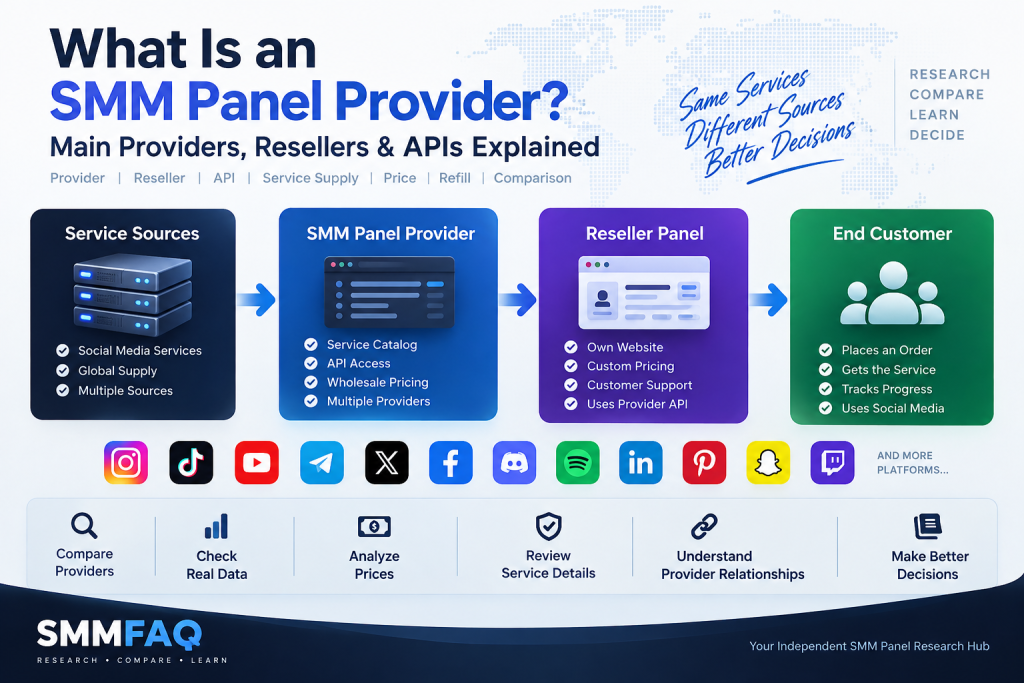
An SMM panel provider is a service source that supplies social media marketing services to SMM panels, resellers, API users, or other platforms.
In practice, however, the word provider can mean different things.
One company may operate part of its own service infrastructure. Another may aggregate services from several upstream sources. A third may simply resell services obtained through another panel’s API.
That is why terms such as main provider, direct provider, API provider, and reseller should not automatically be treated as proof of where a service originally comes from.
Understanding the difference is useful when comparing prices, service limits, refill conditions, API availability, and provider relationships.
If you are new to the industry, start with our guide on What Is an SMM Panel? before continuing.
What Is an SMM Panel Provider?
An SMM panel provider is a company or platform that makes SMM services available to other users or businesses.
These services can include:
Instagram followers, TikTok likes, YouTube views, Telegram members, reactions, comments, watch time, impressions, saves, shares, and many other platform-specific services.
A provider usually exposes those services through a website, an API, or both.
For example, a reseller panel may connect to a provider through an API. When a customer places an order on the reseller’s website, that order can be forwarded automatically to the provider.
The reseller controls the customer-facing website and pricing, while the provider handles the upstream service order.
That does not necessarily mean the provider is the original source of the service. The provider itself may also use another upstream supplier.
This is one of the reasons SMM supply chains can be difficult to identify from the outside.
How Do SMM Panel Providers Supply Services?
There is no single supply model used across the entire SMM industry.
Some providers operate services directly. Others combine their own services with external sources. Some operate mainly as aggregators.
A simplified supply chain can look like this:
Service source → Provider → Reseller panel → Customer
But it may also look like:
Service source → Provider A → Provider B → Reseller → Customer
Or:
Multiple service sources → Aggregator → API panel → Resellers
The number of layers is not always visible to the end user.
Two different panels can therefore list what appears to be the same service while actually sourcing it through different routes.
The opposite can also happen: several panels may be selling the exact same upstream service under different names and at different prices.
What Does “Main Provider” Mean in SMM Panels?
Main provider is an informal industry term rather than a standardized technical classification.
It is commonly used to suggest that a panel is closer to the original supply source or acts as a major upstream supplier for other panels.
But the term itself does not prove this.
A website describing itself as a “main provider” may be:
- operating some services directly,
- aggregating several upstream providers,
- supplying many reseller panels,
- offering competitive wholesale pricing,
- or simply using the phrase as marketing terminology.
Because there is no universal certification for a “main provider,” the label should be evaluated alongside actual information such as API availability, service catalog structure, pricing patterns, service IDs, provider history, and documented service behavior.
This distinction is especially important when researching claims such as “main SMM panel provider” or “direct provider.”
SMM Provider vs Reseller
A provider and a reseller can look almost identical from the customer’s perspective.
Both may have:
- thousands of services,
- an API,
- automatic ordering,
- balance deposits,
- refill systems,
- cancellation features,
- and similar website interfaces.
The difference is mainly about where the services are being sourced.
| Feature | Provider | Reseller |
|---|---|---|
| Supplies services upstream | Often | Usually not |
| Uses external providers | May | Commonly |
| Offers API | Common | Common |
| Sets own retail prices | Yes | Yes |
| Can resell another panel’s services | Sometimes | Commonly |
| Automatically means original source | No | No |
A provider may also be a reseller at the same time.
For example, a panel may operate its own Instagram services while sourcing Telegram and YouTube services from external providers.
For that reason, classifying an entire website as either “provider” or “reseller” can sometimes oversimplify how its catalog actually works.
What Is an SMM API Provider?
An SMM API provider allows other panels or applications to access services programmatically.
Instead of manually placing orders on a website, an API client can send requests automatically.
Common API operations include retrieving the service catalog, creating an order, checking order status, requesting a refill where supported, checking multiple orders, and retrieving account balance.
Many SMM panels use an API structure commonly referred to as API v2.
A typical service response may include fields such as:
| API Field | Meaning |
|---|---|
| Service | Service ID |
| Name | Service name |
| Type | Service/order type |
| Category | Service category |
| Rate | Price per 1,000 units |
| Min | Minimum quantity |
| Max | Maximum quantity |
| Refill | Refill availability |
| Cancel | Cancellation availability |
The exact format can vary between providers.
You can explore the broader API structure in the SMM API research section.
Why Do Reseller Panels Use Providers?
Building and maintaining thousands of separate services would be impractical for many panel operators.
Using providers allows a reseller to build a catalog without operating every service itself.
The reseller can focus on its website, customer support, payment systems, marketing, pricing, user management, and API clients while upstream providers handle service fulfillment.
This structure is common in many digital industries, not only SMM panels.
The important point is that a large service catalog does not necessarily mean that every service is produced by the panel listing it.
Can One SMM Panel Use Multiple Providers?
Yes.
A single panel can use many different providers.
It may even use several providers for the same type of service.
For example, an Instagram followers category could contain dozens of services from different sources, each with different pricing, speed, refill terms, maximum quantities, and quality characteristics.
A panel operator may switch providers when:
a service becomes unstable, prices change, order speed drops, refill performance changes, maximum quantities are reduced, or another source becomes more competitive.
This also explains why service IDs and service names on reseller panels can change frequently.
Why Do SMM Provider Prices Differ?
Price differences can exist even when two services appear similar.
One provider may offer an Instagram service at $0.50 per 1,000 while another lists a similar-looking service at $1.20.
That difference does not automatically mean that the cheaper service is worse or the more expensive service is better.
Several factors can affect the listed price.
Upstream cost, reseller markup, refill coverage, delivery behavior, geographic targeting, order limits, demand, service stability, currency conversion, provider agreements, and the number of supply-chain layers can all influence the final rate.
This is why SMMFAQ treats price as one comparison field rather than a complete quality score.
You can compare current synchronized service records through the SMMFAQ Services database.
Why Can Two Panels Have the Same Service?
API reselling makes duplicate or closely related services common.
Suppose Provider A exposes service ID 500 for Instagram followers.
A reseller connected to Provider A may import that service, rename it, increase the price, and assign its own internal service ID.
Another reseller can do the same thing.
Users may then see:
Instagram Followers | $0.75
on one panel and:
Instagram Followers HQ | $1.10
on another, even though both orders ultimately reach the same upstream provider.
However, identical names do not prove identical sourcing either.
Service naming is not standardized.
This makes provider research more complicated than simply comparing names.
How Can You Tell Whether a Panel Is a Provider or Reseller?
There is rarely one definitive test.
Instead, several signals can be examined together.
A researcher might compare service catalogs, pricing patterns, API structures, service ID changes, update timing, service descriptions, refill behavior, minimum and maximum values, and similarities between multiple panels.
For example, if two panels repeatedly add the same unusual services at approximately the same time with very similar descriptions and limits, they may share an upstream source.
But that is still an indicator rather than proof.
Without internal access to the businesses involved, it is often impossible to confirm the complete supply chain.
SMMFAQ therefore focuses on observable information rather than labeling every panel as definitively “direct” or “reseller.”
Does Having an API Mean a Panel Is a Provider?
No.
This is one of the most common misunderstandings.
A reseller can offer an API just as easily as an upstream provider.
The reseller’s API may simply forward orders to another provider API.
The chain could work like this:
Customer API → Reseller API → Provider API → Service
From the customer’s perspective, everything still happens automatically.
Therefore:
API access proves automation capability, not service ownership.
This distinction is useful when evaluating claims that a panel is a “direct API provider.”
Does a Large Service Catalog Mean a Panel Is a Main Provider?
Not necessarily.
A catalog containing 10,000 or 20,000 services can be built by combining multiple external providers.
In fact, aggregation can sometimes produce a larger catalog than a direct source would maintain independently.
Catalog size can still be useful information, but it should not be interpreted alone.
A large catalog tells you that many services are available through that panel.
It does not tell you who originally supplies them.
What Should You Compare Between SMM Providers?
When researching providers, SMMFAQ recommends looking at several observable fields rather than relying on marketing labels.
The most useful comparison points are service rate, minimum and maximum quantity, refill availability, cancellation support, service description, catalog size, API availability, supported platforms, target markets, update frequency, provider history, and whether the provider clearly documents its service conditions.
No single field should be treated as a complete quality indicator.
A provider with the cheapest price may have different limits or refill terms from a more expensive listing.
Likewise, an expensive service is not automatically more reliable.
SMMFAQ Provider Research
SMMFAQ maintains a dedicated Provider Research directory for examining SMM panel providers in a structured format.
Provider profiles can contain information such as:
provider website, API availability, synchronized service count, service focus, markets, platforms, catalog information, and the latest research or synchronization context.
The directory is designed for research rather than ranking.
A provider appearing first in the directory does not mean SMMFAQ considers it better than another provider.
Where synchronized catalog information is available, provider profiles can also connect directly to the corresponding services in the SMMFAQ service database.
This makes it possible to move from:
Provider → Catalog → Individual services → Price and service fields
without relying only on promotional descriptions.
Main Provider vs Cheapest Provider
“Main provider” and “cheapest provider” are not the same concept.
A provider could be close to an upstream service source but still charge higher rates.
Another panel could offer a lower price because of negotiated rates, lower markup, temporary pricing changes, or an entirely different service source.
Likewise, the cheapest listing does not reveal where the service originates.
If the goal is price research, compare rates directly.
If the goal is supply-chain research, examine provider relationships and catalog similarities.
These are different questions.
Are SMM Panel Providers Safe to Use?
The word provider alone does not establish safety, reliability, or service quality.
Before using any third-party platform, users should review its current terms, payment policies, privacy practices, support information, service descriptions, and refund or refill conditions.
Account-level risks can also depend on the social platform involved and how a service is delivered.
SMMFAQ’s provider research should therefore be treated as informational data rather than a guarantee about future service performance.
Final Thoughts
An SMM panel provider is best understood as a supplier within the SMM service ecosystem.
Some providers may operate services directly. Others aggregate multiple sources. Some primarily sell to resellers through APIs, while others serve both end users and API customers.
The industry’s terminology is not standardized.
That is why labels such as main provider, direct provider, or API provider should be examined alongside actual service data rather than accepted as proof of a particular supply-chain position.
For practical research, compare the fields that can actually be observed: pricing, limits, refill, cancellation, API availability, platforms, catalog size, update dates, and provider information.
You can continue researching through the SMMFAQ Provider Directory or compare synchronized listings in the SMMFAQ Services Database.
Frequently Asked Questions
What is an SMM panel provider?
An SMM panel provider is a platform or company that supplies social media marketing services to SMM panels, resellers, API users, or direct customers.
What is a main provider in SMM panels?
“Main provider” is an informal industry term usually used for an upstream or major service supplier. There is no universal certification for the term, so the label alone does not prove that a company is the original service source.
What is the difference between an SMM provider and a reseller?
A provider supplies services upstream, while a reseller generally obtains services from another source and sells them to its own customers. A business can perform both roles for different services.
Can a reseller have an SMM API?
Yes. A reseller can expose its own API while forwarding incoming orders to another provider through an upstream API.
Does having cheap prices mean a panel is a main provider?
No. Low pricing can result from many factors including markup, supplier agreements, promotions, exchange rates, or different upstream services.
Can an SMM panel use several providers?
Yes. Many panels can combine services from multiple sources and may use different providers for different platforms or service types.
Does SMMFAQ rank SMM providers?
No. SMMFAQ’s provider directory is designed to organize research information and service data. Directory placement does not represent an overall provider ranking.