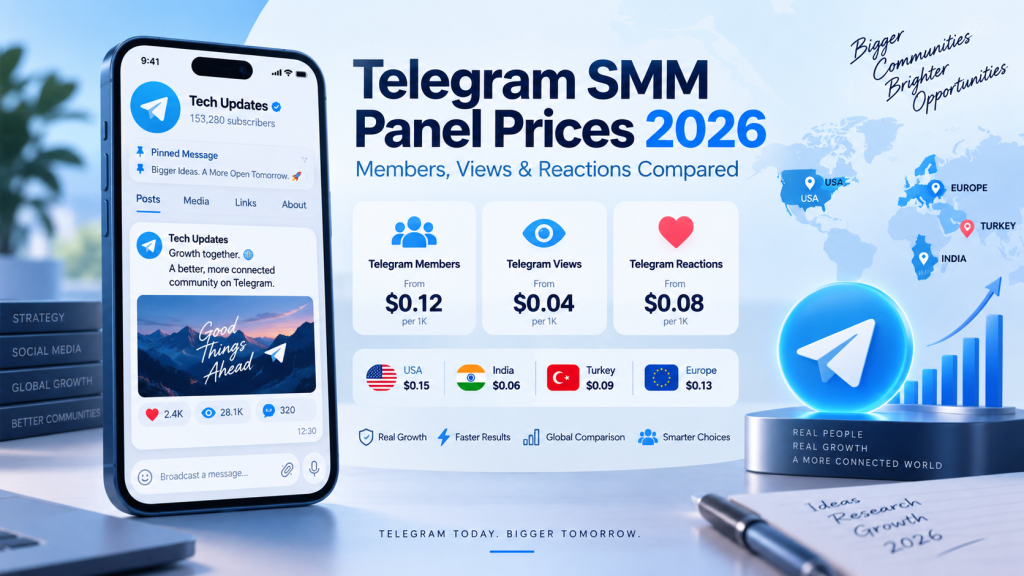
Telegram SMM panel prices in 2026 can differ dramatically depending on whether the service delivers channel members, group members, post views, reactions, comments, votes or Premium-related services.
That makes Telegram pricing different from a simple “price per follower” comparison.
A Telegram catalog may contain several services that appear similar but have completely different:
- target types,
- provider sources,
- refill periods,
- maximum quantities,
- delivery methods,
- country targeting,
- and pricing.
The SMMFAQ Telegram Services Database is designed to compare these fields directly. It currently organizes synchronized Telegram listings around provider, service, price per 1K, min/max, refill, cancel and update time.
How Much Do Telegram SMM Services Cost in 2026?
There is no single Telegram SMM price.
A Telegram service catalog can contain:
Channel Members
Group Members
Post Views
Story Views
Reactions
Comments
Poll Votes
Premium Members
Channel Boosts
Auto Views
Country-Targeted Members
Each category has a different supply model.
Current public market research illustrates the difference clearly. One 2026 service guide places basic post views at a much lower typical rate than member services, while reactions and higher-tier channel members occupy higher price ranges.
That does not establish a universal market price.
It demonstrates the more important point:
Telegram service type has a major effect on price.
Telegram Channel Members Prices
Channel members are one of the main Telegram SMM categories.
A panel might offer:
Telegram Members | Global
Telegram Members | 30D Refill
Telegram Members | 90D Refill
Telegram Members | Turkey
Telegram Members | USA
Telegram Members | Premium
Telegram Members | Fast
These are not automatically equivalent services.
A broad public comparison index updated in September 2026 shows very large differences even among member listings, which reinforces why one advertised rate should not be treated as “the Telegram member price.”
Why Do Telegram Member Prices Vary So Much?
One important variable is member type.
A low-cost generic member service may use a different account pool from:
Premium Members
Country-Targeted Members
Long Refill Members
Older Accounts
Another variable is the refill condition.
A service with no refill and a service with a 90-day refill should not automatically be compared as identical products.
The provider itself can also be different.
Two panels may display nearly identical Telegram member names while routing orders to completely different upstream sources.
Telegram Group Members vs Channel Members
Group members and channel members should be researched separately.
A Telegram channel is primarily a broadcast structure.
A Telegram group is designed around member participation and discussion.
That difference can affect the service source, acceptable link type and delivery method.
Current public Telegram catalogs commonly separate channel members and group members as distinct service categories rather than treating them as one product.
For price research, compare:
Channel Members → Channel Members

Group Members → Group Members
rather than mixing both into one average.
Telegram Post Views Prices
Post views can be dramatically cheaper per 1,000 than members.
That is because a view and a joined account represent very different delivery requirements.
For example:
1,000 Post Viewsdoes not require the same account behavior as:
1,000 Channel MembersCurrent 2026 Telegram comparison pages show post-view listings at substantially lower prices than member services.
This is why a Telegram panel may advertise extremely low “Telegram prices” while the cheapest listing is actually a views service rather than members.
What Does Price per 1K Mean?
If a Telegram member service is listed at:
$1.00 / 1Kthen, in a standard per-1,000 pricing model:
1,000 members = $1
10,000 members = $10
50,000 members = $50
provided that the service supports those quantities.
The calculation is:
Quantity ÷ 1,000 × RateHowever, not every Telegram service uses the same billing logic.
Some Premium features, boosts or specialized packages can be priced differently.
Always check the actual service unit.
Minimum and Maximum Quantity Matter
Suppose two Telegram member services look like this:
| Service | Price / 1K | Min | Max |
|---|---|---|---|
| Service A | $0.50 | 100 | 10K |
| Service B | $0.80 | 50 | 500K |
Service A is cheaper.
But someone researching a 100,000-member order cannot use Service A if its maximum is 10,000.
This is why price without order limits can be misleading.
Telegram Reactions Prices
Telegram reactions are another distinct market.
A reaction service may deliver:
👍
❤️
🔥
👏
😁
🤩
or a mixed reaction set.
Some services allow one selected emoji.
Others provide random or mixed reactions.
Current public Telegram guides typically price reactions separately from views and members because they represent another service type.
Why Reaction Services Need Their Own Comparison
Imagine:
Service A
Telegram Reactions | Random
and:
Service B
Telegram Reactions | Custom Emoji
Even if both say “reactions,” they may not offer the same functionality.
A useful price comparison therefore checks:
- reaction type,
- quantity,
- supported post type,
- provider,
- rate,
- and maximum.
Telegram Poll Votes
Some SMM catalogs also contain Telegram poll-vote services.
These can be structured differently because a user may need to specify:
Poll URL
Option
Quantity
A poll-vote service should not be compared directly with post reactions or views.
Its own market and supply characteristics determine the price.
Telegram Premium Members and Boosts
Telegram Premium-related services can cost more because the supply pool is more restricted.
Examples can include:
Premium Members
Premium Subscribers
Channel Boosts
Story Boosts
These services should be researched independently from generic members.
A “Premium member” listing and a budget member listing may both increase the visible member count while having completely different service conditions.
Why Can Telegram Views Be Extremely Cheap?
One factor is scale.
A post-view service may support extremely large quantities.
For example:
Max: 10Mor higher.
A member service may have a much smaller maximum.
Higher available supply can correspond to a lower per-unit rate.
That does not mean the view service is “better.”
It simply represents a different type of product.
Telegram Prices Can Differ by Country
Country-targeted Telegram services can include:
Turkey Members
USA Members
India Members
Brazil Members
Germany Members
Arab Members
These should ideally be compared with services targeting the same geography.
For example, a current Turkey-focused market dataset reports hundreds of Turkey-targeted Telegram member listings with a considerably different price profile from generic global member services.
This shows why:
Global Telegram Membersand:
Turkey Telegram Membersshould not be treated as the same pricing category.
Country Is Not the Only Variable
Suppose:
| Service | Target | Refill | Max |
|---|---|---|---|
| A | Turkey | No | 10K |
| B | Turkey | 30D | 100K |
| C | Turkey | 90D | 1M |
All three target the same country.
Yet the service conditions are substantially different.
The price difference cannot automatically be attributed to geography.
Does Refill Affect Telegram Member Prices?
It can.
Telegram member services can experience drops when accounts disappear or providers rotate supply.
A refill period creates an additional service condition.
For example:
No Refill
30 Days
60 Days
90 Days
365 Days
should be recorded separately.
For the mechanics, see What Does Refill Mean in an SMM Panel?.
Does “Non-Drop” Mean Members Can Never Drop?
No standardized technical definition exists for marketing terms such as:
Non-Drop
Stable
Premium
Real
HQ
Organic
Different providers can use these labels differently.
For research purposes, measurable fields such as:
Refill
Min
Max
Provider
Price
Updated
are more useful than an adjective in the service name.
Telegram Auto Views
Auto-view services are particularly interesting because they may apply to future posts.
Instead of ordering a view service separately for every post, some systems can automatically deliver views after new posts appear.
This makes them fundamentally different from:
Views on one existing postA price comparison should verify whether the listing is:
Single Post Views
Last X Posts
Auto Views
Future Posts
before comparing rates.
Telegram Views for Multiple Posts
Some Telegram services can apply a quantity to several recent posts.
For example:
Views on Last 5 Posts
Views on Last 10 Posts
Views on Last 20 Posts
The displayed rate may therefore represent a different amount of total delivery than a standard single-post service.
This is another reason price alone is insufficient.
Public vs Private Telegram Targets
The type of Telegram link can also matter.
A public channel might use:
t.me/channelnamewhile a private target may require an invite link.
Not every service accepts both.
Current Telegram service guides specifically distinguish public targets from private invite-link workflows.
A service that supports private targets may use a different delivery system and price.
Why the Exact Link Format Matters
Different Telegram services can expect:
Channel Username
Post URL
Group Invite Link
Poll URL
These inputs are not interchangeable.
Ordering the wrong service type can cause the order to fail even when the quantity and price are valid.
Example Telegram Member Comparison
Consider three hypothetical services:
| Service | Price / 1K | Max | Refill | Cancel |
|---|---|---|---|---|
| Member A | $0.30 | 20K | No | No |
| Member B | $0.75 | 250K | 30 Days | Yes |
| Member C | $1.50 | 1M | 90 Days | Yes |
We can objectively say:
Member A has the lowest listed rate.
Member C has the highest maximum.
Member B and C list refill support.
But we cannot establish from these fields alone that one is universally better.
That is the same principle used in How to Compare SMM Panels Using Real Data.
Cheapest Telegram Price vs Typical Telegram Price
This distinction is particularly important.
Suppose a dataset contains:
$0.05
$0.40
$0.45
$0.48
$0.50
$0.53
$0.55
The minimum is:
$0.05But the majority of listings are clustered around:
$0.40 – $0.55Publishing only $0.05 can make the market appear much cheaper than the typical listing.
A useful SMMFAQ study should therefore eventually report:
| Metric | Meaning |
|---|---|
| Lowest | Minimum observed rate |
| Median | Middle of the dataset |
| Highest | Upper observed rate |
| Listings | Number of records analyzed |
| Providers | Number of sources |
| Updated | Data freshness |
Why Median Price Matters
The median is useful because one extremely cheap or expensive service has less influence on it.
For example:
0.10
0.45
0.50
0.52
9.00
The market midpoint is closer to:
$0.50than the average might suggest.
This is particularly useful for highly variable SMM catalogs.
Why Telegram Service Data Changes
Telegram services can change because:
- provider supply changes,
- account pools change,
- services are disabled,
- rate changes occur,
- refill is removed,
- max quantity changes,
- or a panel remaps the service.
That makes last updated an important research field.
SMMFAQ’s Telegram research page explicitly notes that synchronized data can change and should be checked against current provider terms.
Why Old Price Lists Become Unreliable
Suppose an article published six months ago says:
Telegram Members: $0.50 / 1KSince publication, the upstream provider could have:
raised the price
replaced the service
removed refill
reduced max
disabled it entirely
The text remains online while the actual market has changed.
This is why SMMFAQ separates editorial explanations from a live synchronized service database.
How SMMFAQ Approaches Telegram Pricing
The SMMFAQ Telegram Services Database currently provides dedicated research for:
Telegram Members
Telegram Views
Telegram Reactions
Telegram Group Members
and sorts synchronized provider-catalog results by price by default.
That means the article can explain pricing methodology while the database handles current service records.
What Should a Telegram Price Study Measure?
For each Telegram service category, useful fields include:
| Metric | Why It Matters |
|---|---|
| Lowest price | Market floor |
| Median price | Typical midpoint |
| Highest price | Market spread |
| Provider count | Breadth |
| Listing count | Sample size |
| Refill % | Service conditions |
| Cancel % | Order management |
| Median maximum | Capacity |
| Updated date | Freshness |
This is more informative than publishing one cheapest provider.
Members vs Views vs Reactions
Telegram’s major service types answer completely different questions.
Members affect channel or group size.
Views affect the visible view count on posts.
Reactions affect engagement shown beneath posts.
Because their supply systems differ, their prices should be analyzed separately.
Why “Telegram SMM Panel Price” Is Too Broad
A person searching for:
telegram smm panel pricesmay actually be looking for:
telegram members price
telegram views price
telegram reactions price
telegram group members price
telegram premium members price
A strong page should therefore explain the category and then guide the user toward the exact service.
That is why this article acts as the broad Telegram price hub rather than creating dozens of thin pages.
How Much Do 10,000 Telegram Members Cost?
Once the current rate is known, the calculation is simple.
At:
$0.50 / 1K10,000 members would be:
$5At:
$1.50 / 1Kit becomes:
$15At:
$5 / 1Kit becomes:
$50These are mathematical examples, not market quotes.
The actual service must also support at least 10,000 members.
How Much Do 100,000 Telegram Views Cost?
At:
$0.01 / 1K100,000 views would cost:
$1At:
$0.10 / 1Kthe cost becomes:
$10Again, the service’s maximum quantity and delivery rules must be checked first.
Should Telegram Members and Views Be Ordered Together?
From a price-research perspective, they should be treated as separate services.
A channel can have:
member countand:
view count per postas separate public metrics.
There is no single price relationship that applies to all channels.
SMMFAQ should therefore compare each service independently rather than prescribe a particular combination.
Can Two Telegram Panels Sell the Same Upstream Service?
Yes.
Multiple panels can source Telegram services from the same provider or aggregator.
They may then apply different markup.
A simplified chain could look like:
Provider
↓
Aggregator
↓
Panel A
Panel B
Panel C
The service can therefore appear at several prices.
For more context, see How Do SMM Panels Get Their Services?.
Provider Location Does Not Equal Telegram Targeting
A panel can operate in one country and sell:
USA Telegram Members
Turkey Telegram Members
India Telegram Members
Global Telegram Members
The panel’s business location and the service’s geographic label are different concepts.
This distinction is also important in SMM Panel Prices by Country.
What Is the Best Way to Compare Telegram Prices?
Start with the exact service type.
Then compare the same fields across several listings.
A useful workflow is:
Service → Price → Min/Max → Refill → Cancel → Provider → Updated
This avoids comparing products that only share the word “Telegram.”
Telegram SMM Pricing in 2026: Key Takeaways
The most important points are straightforward.
Telegram does not have one universal service price.
Channel members, group members, views and reactions need separate comparisons.
Country targeting and Premium-related services can substantially change pricing.
The cheapest listing does not necessarily represent the typical market rate.
Refill and maximum quantity are particularly important for member comparisons.
And because service catalogs change, a current synchronized database is more useful than an old static price list.
Final Thoughts
Telegram SMM panel pricing should be researched at the individual service level.
Instead of asking:
How much does Telegram cost?
a more useful question is:
How much does this exact Telegram service currently cost under comparable conditions?
The key fields are:
Price / 1K
Provider
Service Type
Min
Max
Refill
Cancel
Target
Updated
Use the SMMFAQ Telegram Services Database to research synchronized Telegram services and the SMMFAQ Services Database for broader platform comparisons.
Provider-level information is available through the SMMFAQ Provider Directory.
For background, read Why Do SMM Panel Prices Differ?, How to Compare SMM Panels Using Real Data, How Do SMM Panels Get Their Services? and SMM Panel Prices by Country.
Frequently Asked Questions
How much do Telegram SMM services cost in 2026?
There is no single rate. Channel members, group members, post views, reactions and Premium-related services have different pricing structures.
How much do Telegram members cost per 1,000?
Prices vary widely by provider, targeting, refill and member type. Current public comparison indexes show significant variation even within channel-member services.
Are Telegram views cheaper than members?
They are frequently listed at substantially lower per-1K rates because views and joined members use different delivery models.
Do Telegram reactions have a separate price?
Yes. Reactions are generally listed as their own service category and should be compared separately from views or members.
Why are country-targeted Telegram members more expensive?
They can have a narrower supply pool, but targeting is only one pricing variable. Refill, maximum quantity and provider also matter.
Does refill matter when comparing Telegram members?
Yes. Two member services with different refill periods should not automatically be treated as identical products.
What is the difference between channel members and group members?
They target different Telegram structures and can use different delivery systems, limits and provider sources.
Can Telegram Premium members cost more?
They can because Premium-related account supply is more restricted than generic member supply.
Why do Telegram prices change?
Provider costs, available supply, service remapping, refill conditions and maximum quantities can all change over time.
Where can I compare current Telegram SMM prices?
Use the SMMFAQ Telegram Services Database to compare synchronized service records by price and other measurable fields.