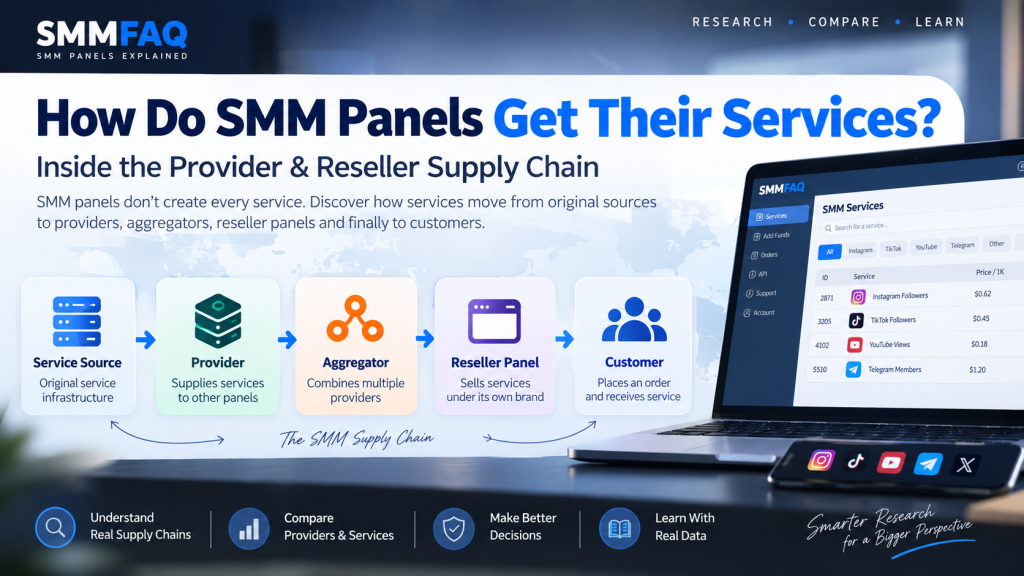
SMM panels do not all create or operate every service listed in their catalogs.
In many cases, services move through a supply chain that can include:
- original service sources,
- upstream providers,
- aggregators,
- reseller panels,
- API clients,
- and customer-facing panels.
That means a service listed on one panel may actually be fulfilled by another platform behind the scenes.
A simplified structure might look like this:
Service Source
↓
Provider
↓
Reseller Panel
↓
Customer
But real supply chains can be more complex.
A single panel may use several providers at the same time, and the same upstream service can appear on many different websites under different names and prices.
To understand this properly, it helps to first understand what an SMM panel provider is.
Where Do SMM Panel Services Come From?
SMM services can come from different sources.
Some providers operate their own delivery infrastructure for certain service categories.
Others combine services from multiple external sources.
Some panels are mainly resellers.
Others act as aggregators that connect many upstream providers into one catalog.
There is no universal model.
A panel could operate:
Instagram services internally
TikTok services through Provider A
YouTube services through Provider B
Telegram services through Provider C
All of those services may still appear together in one customer-facing panel.
That is why a large catalog does not necessarily mean every service comes from the same source.
What Is an Upstream Provider?
An upstream provider is a supplier that another panel depends on for service fulfillment.
For example:
Customer
↓
Panel A
↓
Provider B
Panel A may display the service to the customer, but Provider B handles the actual order.
Panel A controls:
- the website,
- customer account,
- pricing,
- payment process,
- support,
- and local order ID.
Provider B may control:
- upstream service ID,
- fulfillment,
- refill eligibility,
- status,
- and delivery behavior.
The customer may never see Provider B.
What Is an SMM Reseller Panel?
An SMM reseller panel sells services obtained from another provider.
The reseller can rename services, change prices, apply markup, organize categories and present the services under its own brand.
For example:
Provider service:
ID 528
Instagram Followers
$0.40 / 1K
A reseller could import it as:
Local service:
ID 2871
Instagram Followers HQ
$0.62 / 1K
The customer sees service 2871.
But the reseller may send the order upstream to service 528.
This is one reason service IDs should not be compared across panels as if they were universal identifiers.
How Does a Reseller Receive Provider Services?
The most common method is an API connection.
The reseller connects to a provider’s API and retrieves service information.
That data can include:
- service ID,
- name,
- category,
- rate,
- minimum quantity,
- maximum quantity,
- refill,
- cancel,
- and service type.
The reseller can then decide which services to import.
For more detail on this process, see What Is an SMM Panel API?.
What Is Service Mapping?
Service mapping links a reseller’s local service to an upstream provider service.
Example:
Local Service ID:
2005

Provider:
Provider A

Provider Service ID:
739
When a customer orders local service 2005, the panel sends the order to upstream service 739.
The customer does not need to know this relationship.
Mapping allows the reseller to keep its own service IDs and names while using external suppliers.
Can a Panel Change the Provider Behind a Service?
Yes.
This is one of the most important parts of SMM panel infrastructure.
Suppose a reseller has:
Local service:
Instagram Followers
ID: 2005
At first it is mapped to:
Provider A
Service 739
Later Provider A becomes:
- too expensive,
- too slow,
- unstable,
- unavailable,
- or removes the service.
The panel can remap the same local service to:
Provider B
Service 441
From the customer’s perspective, the local service ID may stay exactly the same.
But the upstream source has changed.
Why Would a Panel Keep the Same Local Service ID?
Because changing local IDs can create problems for API customers.
Imagine a reseller has hundreds of API clients using:
Service ID 2005If the reseller deletes that ID and replaces it every time the upstream provider changes, every API client would need to update its own mapping.
Instead, the reseller may keep:
Local ID: 2005and only change the upstream mapping internally.
This makes the system more stable for customers.
Can Two Panels Use the Same Provider?
Yes.
This is very common.
For example:
Panel A
↓
Provider X

Panel B
↓
Provider X

Panel C
↓
Provider X
All three panels could be reselling the same upstream catalog.
However, their customer-facing services can still look different.
They can use different:
- names,
- prices,
- category structures,
- minimums shown,
- descriptions,
- and markups.
This is why two different panels can offer what appears to be the same service.
Can Two Panels Sell the Exact Same Upstream Service?
Yes.
Suppose Provider X offers:
Service 902
Instagram Followers
$0.50 / 1K
Panel A imports it as:
Instagram Followers Fast
$0.65 / 1K
Panel B imports it as:
Instagram Followers Premium
$0.80 / 1K
Panel C imports it as:
IG Followers
$1.10 / 1K
All three could theoretically send orders to Provider X service 902.
Different names do not prove different sources.
Different prices do not prove different sources either.
Why Do Panels Rename Provider Services?
There are several reasons.
Cleaner Customer Experience
Provider descriptions can be long or technical.
A reseller may shorten them.
Branding
A panel may want a consistent naming style.
Language
A panel may translate service names.
Marketing
Words such as:
- fast,
- premium,
- stable,
- high quality,
- real,
- HQ
may be added.
These labels are not standardized across the industry.
That means researchers should not assume that two differently named services are automatically different.
What Is an SMM Aggregator?
An SMM aggregator combines services from multiple providers into one catalog.
Example:
Provider A ─┐
Provider B ─┤
Provider C ─┼→ Aggregator → Reseller Panels
Provider D ─┤
Provider E ─┘
The aggregator can offer a very large service list without directly operating every underlying service.
This model can make the supply chain deeper.
For example:
Original Source
↓
Provider
↓
Aggregator
↓
Reseller
↓
Customer
Each layer can potentially change the price.
Why Do Panels Use Multiple Providers?
Relying on only one provider can create operational problems.
A provider may:
- remove a service,
- increase prices,
- experience downtime,
- become slow,
- run out of capacity,
- or change refill conditions.
Using several providers gives a panel alternatives.
For example:
Instagram:
Provider A + Provider B

TikTok:
Provider C

YouTube:
Provider B + Provider D

Telegram:
Provider E
A larger panel may use many more.
Can One Service Have Multiple Backup Providers?
Yes.
Some systems can keep alternative sources for the same local service.
Example:
Local Service 2005

Primary:
Provider A / Service 739

Backup:
Provider B / Service 441
If the primary service stops working, the panel operator can switch to the backup.
More advanced systems can automate part of this process.
Why Do SMM Services Disappear?
Services can disappear for many reasons.
The upstream provider may:
- delete the service,
- lose its source,
- disable new orders,
- change platform strategy,
- reach capacity,
- or replace the service.
If a reseller synchronizes its catalog automatically, the service may then disappear from the customer-facing panel as well.
This is why SMM service catalogs can change frequently.
Why Do Service Names Suddenly Change?
A service name can change even if the underlying service remains the same.
The provider may update its catalog description.
The reseller may rename it.
The service may be mapped to another source.
Or the panel may reorganize its categories.
Therefore, historical service names are not always reliable identifiers.
Why Do Prices Change When the Provider Changes?
Different providers charge different rates.
Suppose the original source costs:
Provider A:
$0.45 / 1K
The reseller sells it for:
$0.60 / 1KProvider A later becomes unavailable.
The reseller switches to:
Provider B:
$0.70 / 1K
The panel may now increase the customer-facing rate.
The new price could become:
$0.90 / 1KThis is one reason service prices can change even when the service name stays the same.
For a deeper explanation, read Why Do SMM Panel Prices Differ?.
Does a Lower Price Mean a Shorter Supply Chain?
Not necessarily.
A low price can come from:
- a direct source,
- low reseller markup,
- volume pricing,
- negotiated discounts,
- currency differences,
- temporary promotions,
- or another provider entirely.
The number alone does not reveal the full supply chain.
This is why SMMFAQ separates price comparison from provider-source research.
Can a Reseller Be Cheaper Than Its Provider?
It can appear that way in some situations.
For example:
- the reseller may have a discounted provider rate,
- the public provider price may differ from API pricing,
- the reseller may temporarily use a very low markup,
- currency conversion may differ,
- or the reseller may have switched to another source.
Therefore, comparing public prices alone does not always reveal the actual procurement cost.
Does a Large Service Catalog Mean a Panel Is an Aggregator?
Not automatically.
A large catalog can be created in several ways.
The panel may:
- use many providers,
- use one provider with a huge catalog,
- operate part of its own services,
- aggregate several sources,
- or combine all of these models.
Catalog size is useful data, but it does not reveal the business model by itself.
How Do API Orders Move Through the Supply Chain?
Imagine a customer places an order on Panel A.
The process could look like this:
Customer
↓
Panel A order
↓
Panel A API request
↓
Provider B
↓
Provider B service
↓
Delivery
If Provider B is also a reseller:
Customer
↓
Panel A
↓
Provider B
↓
Provider C
↓
Service Source
The customer may only see Panel A.
The other layers are hidden.
Can an Order Pass Through Several APIs?
Yes.
A chain could theoretically be:
Customer
↓
Panel A API
↓
Panel B API
↓
Aggregator API
↓
Provider API
↓
Service
Each system creates its own local order relationship.
This can make troubleshooting more complicated.
For example, the customer sees:
Order ID:
12345
Panel A may store:
Upstream order:
77801
Provider B may then store another upstream ID.
The customer never sees those additional IDs.
Why Can Long Supply Chains Cause Delays?
Every additional layer can introduce:
- API processing,
- synchronization delays,
- provider queues,
- status-update delays,
- and support dependencies.
For example:
Customer asks Panel A
↓
Panel A asks Provider B
↓
Provider B asks Provider C
Support can become slower because the customer-facing panel may not control the underlying service directly.
This does not mean every reseller service is slow.
It simply means more dependencies exist.
How Do Refill Requests Move Through the Supply Chain?
Refill requests can follow a similar route.
Example:
Customer
↓
Reseller Panel
↓
Provider API
↓
Upstream Source
If the service supports refill, the reseller may send the original provider order ID upstream.
This is why refill behavior often depends on the actual provider rather than only the panel selling the service.
For details on refill logic, read What Does Refill Mean in an SMM Panel?.
How Do Cancel Requests Move Through the Supply Chain?
The same applies to cancellation.
A customer may click Cancel on a reseller panel.
That request may then be forwarded to the upstream provider.
If several supply-chain layers exist, the request may need to pass through more than one system.
This helps explain why cancellation is not always instant.
See What Does Cancel Mean in an SMM Panel? for a complete explanation.
Can You Identify a Shared Provider From Service Data?
Sometimes there are clues.
Researchers can compare:
- unusual service names,
- category structure,
- price movements,
- min/max limits,
- refill flags,
- cancel flags,
- timing of new services,
- timing of removed services,
- and simultaneous changes.
For example, if two panels suddenly add the same unusual service with:
Min: 250
Max: 2,000,000
Refill: Yes
Cancel: Yes
at roughly the same time, they may share an upstream source.
But this is still evidence of similarity, not absolute proof.
Why Is It Hard to Prove the Original Service Source?
Because most provider relationships are private.
A public panel generally does not expose:
- upstream API keys,
- internal service mapping,
- provider account IDs,
- procurement contracts,
- or internal order-routing logic.
Without access to those systems, researchers can often identify patterns but cannot always prove the complete chain.
This is why SMMFAQ avoids presenting unverified provider relationships as certain facts.
What Can Be Observed Reliably?
Publicly observable fields are more useful.
These include:
- service name,
- category,
- rate,
- minimum,
- maximum,
- refill,
- cancel,
- provider profile,
- update date,
- API availability,
- service count,
- and market/platform information.
These are the kinds of fields shown in the SMMFAQ Services Database.
How SMMFAQ Researches Provider Catalogs
SMMFAQ uses synchronized provider catalog data to organize service research.
Instead of calling a provider API every time a visitor searches, catalog records can be synchronized into the local database.
This allows visitors to compare fields such as:
Provider
Service ID
Service
Category
Price / 1K
Min / Max
Refill
Cancel
Updated
Provider profiles then add broader context.
You can browse those profiles in the SMMFAQ Provider Directory.
Can SMMFAQ Prove Which Provider Is the Original Source?
Not always.
SMMFAQ can organize observable provider and catalog data.
It can compare patterns.
It can document API availability.
It can track service fields.
But a complete upstream relationship may remain private.
Therefore, terms such as:
- direct source,
- main provider,
- original provider,
- first source
should only be treated as confirmed when there is sufficient evidence.
This distinction is also explained in What Is an SMM Panel Provider?.
Why Is Supply-Chain Research Useful?
Because it helps explain several things that otherwise appear confusing.
For example:
Why two panels have very similar services
They may use the same upstream provider.
Why prices differ
Each panel can use a different markup.
Why services disappear at the same time
Several panels may depend on the same source.
Why refill fails across multiple panels
The same upstream service may be affected.
Why a service name stays the same but behavior changes
The reseller may have changed the provider mapping.
Understanding the supply chain gives context to these changes.
Example: One Service Across Three Panels
Imagine a provider offers:
Provider X
Service 700
TikTok Followers
$0.50 / 1K
Three panels import it.
Panel A
ID: 1040
TikTok Followers
$0.62 / 1K
Panel B
ID: 889
TikTok Followers Fast
$0.75 / 1K
Panel C
ID: 4450
TikTok Premium Followers
$1.05 / 1K
These listings look different.
But they could all be mapped to:
Provider X / Service 700This example shows why:
- service name,
- local ID,
- and retail price
are not enough to identify the true source.
Example: Provider Switching
Now imagine Provider X removes service 700.
Panel A changes its mapping:
Old:
Provider X / Service 700

New:
Provider Y / Service 812
Panel A keeps:
Local ID:
1040
The customer still sees the same local service ID.
But the underlying provider has changed.
The service may now have:
- a new price,
- different refill behavior,
- different speed,
- or different limits.
This is why historical behavior does not always guarantee future behavior for the same local ID.
How Should You Compare SMM Panels With This in Mind?
Do not look only at the panel homepage.
Compare observable data.
Useful questions include:
- How many services are listed?
- Which platforms are covered?
- Is an API available?
- Are prices unusually similar to other panels?
- Do min/max values match?
- Do refill and cancel flags move together?
- Are services added and removed at similar times?
- Does the provider profile show recent catalog synchronization?
SMMFAQ’s Provider Research Directory and Services Database are designed around this type of structured comparison.
Final Thoughts
SMM panels can get their services from many different sources.
Some operate services directly.
Some use upstream providers.
Some combine multiple providers.
Some function mainly as resellers.
Others aggregate many catalogs into one system.
The supply chain may look simple:
Provider
↓
Panel
↓
Customer
or much deeper:
Service Source
↓
Provider
↓
Aggregator
↓
Reseller
↓
Customer
The customer-facing panel does not always reveal what happens behind the scenes.
That is why service IDs, names and prices should be interpreted carefully.
The most useful approach is to compare observable catalog data, provider context and changes over time rather than relying only on labels such as main provider or direct source.
For further research, explore the SMMFAQ Provider Directory, compare live catalog data in the SMMFAQ Services Database, and review the broader explanation in What Is an SMM Panel API?.
Frequently Asked Questions
Where do SMM panels get their services?
SMM panels can source services from direct providers, upstream suppliers, aggregators, reseller panels or a combination of several sources.
Do all SMM panels operate their own services?
No. Many panels use external providers for some or all of their catalog.
What is an upstream SMM provider?
An upstream provider supplies services to another panel or reseller that then sells those services to its own customers.
Can two SMM panels use the same provider?
Yes. Multiple panels can connect to the same upstream provider and sell the same underlying services at different prices.
Why do the same SMM services have different names?
Resellers can rename imported services for branding, translation, categorization or marketing reasons.
What is SMM service mapping?
Service mapping connects a reseller’s local service ID to the corresponding upstream provider service ID.
Can a panel change the provider behind a service?
Yes. A panel can remap a local service to another upstream provider while keeping the same customer-facing service ID.
What is an SMM aggregator?
An SMM aggregator combines services from multiple providers into one catalog and may supply those services to reseller panels.
Does the cheapest panel always have the shortest supply chain?
No. Price can be affected by markup, discounts, provider agreements, currency and other factors.
Can SMMFAQ prove the original provider of every service?
Not always. Provider relationships can be private, so SMMFAQ focuses on observable catalog and provider data rather than presenting uncertain supply-chain relationships as confirmed facts.