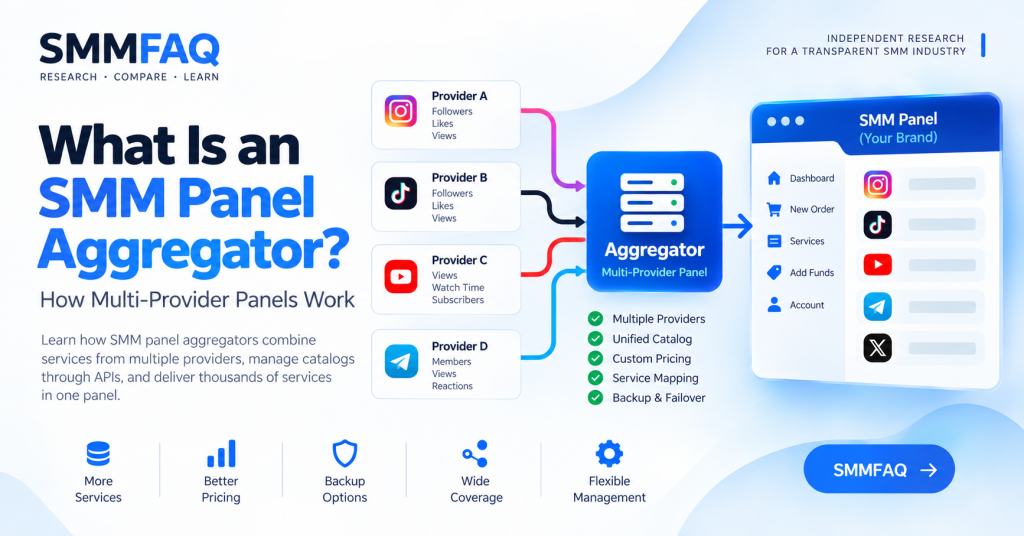
An SMM panel aggregator is a panel that combines services from multiple upstream providers into one catalog.
Instead of relying on one supplier, an aggregator can connect to several SMM APIs, import their services, adjust pricing, rename or reorganize listings, and present everything through a single customer-facing panel.
A simplified structure looks like this:
Provider A ─┐
Provider B ─┼─→ Aggregator Panel ─→ Customer
Provider C ─┘
This model helps explain why one SMM panel can list thousands of services across Instagram, TikTok, YouTube, Telegram and other platforms without necessarily producing every service itself.
If you first want to understand the difference between providers and resellers, read What Is an SMM Panel Provider?.
What Does an SMM Panel Aggregator Do?
An aggregator acts as a collection layer between upstream providers and customers.
It may:
- connect to several provider APIs,
- import service catalogs,
- map similar services,
- apply custom pricing,
- group services by category,
- rename listings,
- monitor provider availability,
- route orders,
- synchronize status,
- handle refill and cancel requests,
- and replace one provider with another when necessary.
The aggregator creates one interface while the actual supply may come from many places.
Is an SMM Aggregator the Same as a Provider?
Not necessarily.
A provider generally refers to the source supplying a service.
An aggregator may collect services from several providers.
For example:
Provider A
Instagram Followers

Provider B
TikTok Likes

Provider C
Telegram Members
An aggregator can combine all three into one catalog.
This creates:
One Panel
Many Providers
One Customer Interface
The distinction is important because a large catalog does not automatically mean the panel is the original source of every service.
Is an Aggregator the Same as a Reseller?
They can overlap, but the terms describe slightly different roles.
A reseller usually sells services obtained from another provider.
An aggregator often manages services from multiple providers.
Example:
Reseller:
Provider A → Panel
Aggregator:
Provider A ─┐
Provider B ─┼→ Panel
Provider C ─┘
An aggregator can therefore also be a reseller.
The difference is the broader multi-provider structure.
Can an Aggregator Also Have Its Own Services?
Yes.
A panel may combine:
- its own services,
- directly sourced services,
- third-party provider services,
- and reseller services.
For example:
Own Instagram Service
+
Provider A TikTok Services
+
Provider B Telegram Services
+
Provider C YouTube Services
This hybrid model is common.
That means one panel should not always be classified using a single label.
Why Do SMM Panels Use Multiple Providers?
There are several reasons.
More Service Coverage
One provider may be strong in Instagram, while another may offer more Telegram or YouTube services.
Using several sources increases catalog coverage.
Better Pricing
Different providers can have different rates.
An aggregator may choose one provider for price and another for availability.
Backup Options
If one provider disables a service, another provider may offer a similar replacement.
Platform Specialization
One provider may specialize in:
- Instagram,
- TikTok,
- YouTube,
- Telegram,
- or regional services.
Combining providers makes the catalog broader.
Risk Distribution
Depending on only one provider creates a single point of failure.
Multiple providers reduce that dependency.
How Does an SMM Aggregator Work Technically?
The core mechanism is usually the API.
A provider API can expose service data such as:
service
name
category
rate
min
max
refill
cancel
The aggregator imports that data into its own system.
For more background, see What Is an SMM Panel API?.
The aggregator may then modify what the customer sees.
For example:
Upstream Name:
Instagram Followers [Provider X] [30D Refill]

Customer-Facing Name:
Premium Instagram Followers | 30 Days Refill
The service may still route back to the upstream provider through the API.
What Is Service Mapping?
Service mapping connects a local service to an upstream provider service.
For example:
Local Service ID: 8421
↓
Provider A Service ID: 190
The customer places an order using local service ID 8421.
The aggregator internally sends the order to provider service 190.
This allows the aggregator to control its own:
- IDs,
- names,
- prices,
- categories,
- descriptions,
- and display order.
Can One Local Service Switch Between Providers?
Yes.
This is one of the most important features of an aggregator model.
Imagine:
Local Service 8421
↓
Provider A Service 190
Provider A later becomes unavailable.
The aggregator may remap:
Local Service 8421
↓
Provider B Service 557
From the customer’s perspective, the local service may still have the same ID.
But the upstream source changed.
This is called remapping.
Why Do Aggregators Remap Services?
Common reasons include:
- provider downtime,
- price increases,
- quality issues,
- refill problems,
- cancel changes,
- low capacity,
- service removal,
- platform restrictions,
- or better alternatives becoming available.
Remapping helps keep a local catalog stable even when upstream services change.
Can a Service ID Stay the Same After the Provider Changes?
Yes.
The aggregator controls the local service ID.
Example:
Customer Service ID: 8421Originally:
Provider A → Service 190Later:
Provider B → Service 557The customer may still see:
Service ID 8421This means a stable service ID does not prove a stable upstream provider.
This is also why service ID matching alone is weak evidence when researching provider relationships.
See How to Tell If Two SMM Panels Use the Same Provider for a deeper explanation.
How Do Aggregators Set Prices?
An aggregator can receive an upstream rate and add markup.
Example:
Provider Rate:
$0.50 / 1K
Aggregator may list:
$0.60 / 1Kor:
$0.75 / 1KPricing can use:
- fixed percentage markup,
- category-based markup,
- service-specific markup,
- customer-group pricing,
- dynamic pricing,
- or manual editing.
For more detail, read Why Do SMM Panel Prices Differ?.
Example of Multi-Provider Pricing
Imagine an aggregator has access to three similar services:
| Provider | Rate / 1K | Refill | Cancel |
|---|---|---|---|
| Provider A | $0.45 | No | No |
| Provider B | $0.62 | 30 Days | Yes |
| Provider C | $0.80 | 90 Days | Yes |
The aggregator could publish all three.
Or it could select only one.
Or it could map one local service to whichever provider currently meets its criteria.
This flexibility is one of the main reasons aggregator structures are used.
Do Aggregators Always Choose the Cheapest Provider?
No.
Price is only one variable.
An aggregator may consider:
- refill,
- cancel,
- max quantity,
- availability,
- historical stability,
- platform compatibility,
- API response,
- capacity,
- and support behavior.
The cheapest upstream rate may not always be the preferred source.
How Are Orders Routed?
A simplified order process may look like this:
Customer
↓
Aggregator Panel
↓
Local Service Mapping
↓
Selected Provider API
↓
Upstream Order
The aggregator then stores a relationship between:
Local Order ID
↔
Provider Order ID
This allows status updates to be synchronized later.
How Are Order Statuses Synchronized?
The aggregator may periodically ask the upstream provider:
What is the status of order 785421?The provider may return:
Pending
Processing
Completed
Partial
Canceled
The aggregator then updates the customer-facing order.
The same logic can apply to multiple providers.
How Does Refill Work in an Aggregator?
If the local service supports refill, the aggregator may forward the refill request to the upstream provider.
Example:
Customer Refill Request
↓
Aggregator
↓
Provider API
↓
Provider Refill System
The aggregator itself may not perform the refill.
It may simply pass the request upstream.
For terminology, see What Does Refill Mean in an SMM Panel?.
How Does Cancel Work?
Cancel can work similarly.
Customer Cancel Request
↓
Aggregator
↓
Upstream Provider
The final result depends on whether the upstream provider accepts cancellation.
That means a cancel button on the customer-facing panel can still depend on third-party provider behavior.
See What Does Cancel Mean in an SMM Panel? for more context.
Why Can an Aggregator Have Thousands of Services?
Because it can import multiple catalogs.
Example:
Provider A: 2,000 services
Provider B: 4,000 services
Provider C: 3,500 services
Provider D: 1,500 services
In theory, the aggregator may have access to:
11,000 servicesbefore deduplication or filtering.
This does not mean all services are unique.
Many may overlap.
What Is Catalog Duplication?
Two providers may offer similar or identical services.
Example:
Provider A:
Instagram Followers | $0.50

Provider B:
Instagram Followers | $0.55

Provider C:
Instagram Followers | $0.60
An aggregator may:
- list all three,
- hide duplicates,
- rename them,
- or map one local service to one preferred provider.
This is where service management becomes important.
Why Do Aggregators Rename Services?
There are several reasons.
They may want to:
- simplify names,
- remove provider branding,
- standardize categories,
- improve readability,
- add local terminology,
- or create consistent catalog formatting.
For example:
Provider Service:
IG FOLLOWERS | HQ | R30 | MIXED | FAST
could become:
Instagram Followers | 30 Day Refill | FastThis means service names alone cannot reliably identify the original provider.
What Happens If an Upstream Provider Goes Offline?
The aggregator can be affected in several ways.
Orders may:
- remain pending,
- slow down,
- stop updating,
- fail refill,
- lose cancel functionality,
- or become unavailable.
A well-designed aggregator may switch to another source.
But switching is not always seamless.
What Is Provider Failover?
Provider failover means using an alternative upstream source when the original source is unavailable.
Example:
Primary Provider
↓ unavailable

Backup Provider
↓
Order Routing
This can improve continuity.
But it can also change:
- price,
- speed,
- refill rules,
- cancel rules,
- and delivery characteristics.
Can Two Orders on the Same Local Service Use Different Providers?
Potentially, yes.
If the routing system changes between orders, this can happen:
Order 1
Local Service 8421
→ Provider A
Later:
Order 2
Local Service 8421
→ Provider B
This is another reason historical service behavior can change even when the visible service ID remains the same.
What Is a Multi-Provider SMM Panel?
A multi-provider SMM panel is simply a panel connected to more than one upstream service source.
An aggregator is a common form of multi-provider panel.
The panel may combine several providers manually or automatically.
Aggregator vs Single-Provider Panel
| Feature | Single Provider Panel | Aggregator |
|---|---|---|
| Number of upstream sources | Usually one | Multiple |
| Catalog breadth | More limited | Often broader |
| Backup options | Limited | Potentially higher |
| Service remapping | Less common | Common |
| Price sources | One main source | Multiple |
| API complexity | Lower | Higher |
| Catalog duplication | Lower | Higher |
| Routing logic | Simpler | More complex |
Neither model is automatically better.
They are simply different architectures.
Aggregator vs Reseller
| Feature | Reseller | Aggregator |
|---|---|---|
| Uses upstream services | Yes | Yes |
| Can use one provider | Yes | Possible |
| Usually uses multiple providers | Not required | Common |
| Catalog merging | Limited or none | Core function |
| Service mapping | Possible | Common |
| Provider selection logic | Basic | Often more advanced |
An aggregator is often a more complex form of reseller operation.
Aggregator vs Main Provider
The phrase main provider is often used loosely in the SMM industry.
It may mean:
- original service source,
- direct supplier,
- large upstream provider,
- or simply a marketing label.
An aggregator can have a very large catalog without being the original source of most services.
Therefore:
Large Catalog ≠ Original ProviderHow Can You Identify an Aggregator?
Possible signs include:
- very large service catalog,
- many platforms,
- frequent provider-like naming changes,
- multiple price tiers for similar services,
- broad refill/cancel combinations,
- synchronized API updates,
- service remapping behavior,
- and catalog diversity.
These signs suggest an aggregator structure but do not prove it.
Can One Aggregator Resell Another Aggregator?
Yes.
The supply chain can be layered.
Example:
Provider
↓
Aggregator A
↓
Aggregator B
↓
Reseller
↓
Customer
This can create several levels between the original source and final customer.
For a broader supply-chain explanation, see How Do SMM Panels Get Their Services?.
Why Does Supply-Chain Depth Matter?
Each layer can add:
- markup,
- delay,
- support dependency,
- API dependency,
- refill routing,
- cancel routing,
- and synchronization risk.
For example:
Customer
↓
Panel D
↓
Panel C
↓
Aggregator B
↓
Provider A
A refill request may need to move through several systems.
That can make debugging more difficult.
How Does an Aggregator Affect Pricing?
Every layer may add markup.
Example:
Provider: $0.40
Aggregator: $0.48
Reseller: $0.60
Final Panel: $0.75
This can help explain why the same or similar service appears at different prices across multiple panels.
Why Do Similar Services Appear on Many Panels?
Because several panels may import from the same aggregator or provider.
For example:
Provider A
↓
Aggregator X
↓
Panel 1
Panel 2
Panel 3
Panel 4
All four panels may show similar:
- names,
- limits,
- refill,
- cancel,
- price movement,
- and service availability.
This is one of the reasons provider research often focuses on patterns rather than names alone.
What Are the Advantages of an Aggregator Model?
Potential advantages include:
- wider service coverage,
- multiple provider options,
- backup sources,
- flexible pricing,
- platform specialization,
- faster catalog expansion,
- and less dependence on one supplier.
These are architectural benefits.
They do not guarantee quality.
What Are the Risks of an Aggregator Model?
Potential risks include:
- more complex routing,
- inconsistent service behavior,
- provider dependency,
- remapping differences,
- stale catalog data,
- API synchronization problems,
- and more difficult troubleshooting.
More providers mean more flexibility, but also more moving parts.
What Makes a Good Aggregator System?
A well-managed aggregator typically needs:
- reliable API synchronization,
- clear service mapping,
- provider health monitoring,
- accurate status updates,
- price synchronization,
- duplicate management,
- refill routing,
- cancel routing,
- provider failover,
- and logging.
Without these systems, a large catalog can become difficult to manage.
Why Is Data Freshness Important?
Provider data changes frequently.
A service can change:
- price,
- min,
- max,
- refill,
- cancel,
- name,
- category,
- or availability.
An aggregator must keep its local catalog synchronized.
Outdated data can lead to:
- wrong pricing,
- invalid limits,
- failed orders,
- unavailable refill,
- or broken routing.
How Often Should Aggregator Catalogs Be Synchronized?
There is no universal interval.
It depends on:
- provider update frequency,
- catalog size,
- API limits,
- service volatility,
- and system architecture.
Some data may need frequent updates.
Other fields may change less often.
The important part is that the displayed information should not remain stale for long periods.
Can Aggregators Automatically Choose the Best Provider?
Technically, yes.
A routing system could compare:
- rate,
- availability,
- refill,
- cancel,
- historical performance,
- max quantity,
- and provider status.
Then it could select a provider automatically.
For example:
If Provider A unavailable
→ Use Provider B

If Provider B price too high
→ Use Provider C
This is similar to routing logic used in other API-based industries.
Does Automatic Routing Guarantee Better Results?
No.
Automatic routing is only as good as the data and rules behind it.
A system can make decisions based on incomplete information.
For example, the lowest rate may not correspond to:
- best availability,
- best refill support,
- or most stable service.
That is why routing criteria matter.
How Can SMMFAQ Research Aggregator Structures?
SMMFAQ can compare observable provider and service data.
The SMMFAQ Services Database allows service-level research using fields such as:
- provider,
- service ID,
- category,
- price,
- min,
- max,
- refill,
- cancel,
- and update date.
The SMMFAQ Provider Directory adds broader provider context.
These datasets can help identify:
- catalog overlap,
- similar services,
- repeated pricing relationships,
- and possible multi-provider patterns.
They should be used as research signals rather than automatic proof of ownership or supplier relationships.
How Is an Aggregator Different From a Marketplace?
An aggregator usually controls the customer-facing catalog and routing logic.
A marketplace may allow different suppliers to list independently.
In an aggregator model:
Aggregator controls catalog
↓
Customer sees one unified interface
In a marketplace:
Multiple sellers
↓
Customer may see separate sellers
The exact terminology can vary across platforms.
What Is the Difference Between Aggregation and White Label?
Aggregation refers to combining supply from multiple providers.
White label refers to branding software or services under another company’s brand.
A panel can be:
- an aggregator,
- a white-label panel,
- both,
- or neither.
These are separate concepts.
Can an Aggregator Be White Label?
Yes.
For example:
White-Label Software
+
3 Provider APIs
+
Custom Branding
=
White-Label Aggregator Panel
This is why front-end appearance alone reveals very little about the underlying supply chain.
How Should Users Compare Aggregator Panels?
Instead of asking only:
How many services does this panel have?
compare:
- service price,
- provider context,
- min/max,
- refill,
- cancel,
- update date,
- API availability,
- and platform coverage.
For a structured comparison method, read How to Compare SMM Panels Using Real Data.
Does a Bigger Aggregator Mean Better Services?
No.
A large catalog proves only that the panel lists many services.
It does not automatically establish:
- better quality,
- better support,
- better refill,
- lower prices,
- or greater reliability.
Catalog size is one research field.
It should not be treated as an overall quality score.
Is an Aggregator More Reliable Than a Single Provider?
Not automatically.
An aggregator may have more backup options.
But it also has more dependencies.
A single-provider system may be simpler.
An aggregator may be more flexible.
Reliability depends on how the system is operated.
Can Aggregators Create Duplicate Services?
Yes.
This is common when multiple providers offer similar products.
Example:
Instagram Followers #1
Instagram Followers #2
Instagram Followers #3
Instagram Followers #4
They may all come from different sources.
Or some may share upstream providers.
The customer-facing catalog does not always reveal this.
Why Can Two Services Have Similar Features but Different Prices?
Possible reasons include:
- different providers,
- different markup,
- different refill,
- different cancel,
- different max quantity,
- different routing,
- or simply different pricing strategies.
The same visible category can contain several different upstream services.
Can Aggregators Change Providers Without Telling Users?
Technically, yes, if the panel controls the local mapping.
Whether they disclose that change depends on the platform.
This is one reason historical data can be useful when researching service behavior.
Why Historical Data Matters
A snapshot tells you:
What the service looks like nowHistorical data can show:
How it changed
When it changed
Which other services changed with it
This can reveal patterns that are invisible in a single current catalog.
A Simple Aggregator Example
Imagine one panel uses three providers.
Provider A
Instagram

Provider B
TikTok

Provider C
Telegram
The customer sees:
One Website
One Balance
One API
One Order History
Behind the scenes:
Three different upstream systemsThat is the basic aggregator concept.
A More Advanced Aggregator Example
Now imagine this:
Instagram Followers
→ Provider A

Instagram Likes
→ Provider B

Instagram Views
→ Provider C

TikTok Followers
→ Provider D

Telegram Members
→ Provider E
The panel may then have backup providers for each service.
This creates a provider network rather than a single-provider relationship.
What Should Researchers Avoid Assuming?
Avoid assumptions such as:
Big panel = provider
Cheap panel = main provider
Many services = original source
Same service ID = same provider
Same service name = same source
These shortcuts can lead to incorrect conclusions.
Use multiple observable fields instead.
Final Thoughts
An SMM panel aggregator is a system that combines services from multiple upstream providers into one customer-facing catalog.
The aggregator may:
- import catalogs through APIs,
- remap services,
- add markup,
- rename listings,
- route orders,
- synchronize statuses,
- manage refill and cancel,
- and switch providers when needed.
The most important distinction is:
An aggregator organizes and routes supply. It does not necessarily produce every service it sells.
This helps explain why a single panel can contain thousands of services, why prices differ between panels, and why similar services can appear across many websites.
Use the SMMFAQ Services Database to compare service-level data and the SMMFAQ Provider Directory to research broader provider structures.
For related reading, see How Do SMM Panels Get Their Services?, What Is an SMM Panel Provider?, What Is an SMM Panel API?, How to Tell If Two SMM Panels Use the Same Provider, and How to Compare SMM Panels Using Real Data.
Frequently Asked Questions
What is an SMM panel aggregator?
An SMM panel aggregator combines services from multiple upstream providers into one customer-facing service catalog.
Is an SMM aggregator the same as a reseller?
Not exactly. A reseller may depend on one provider, while an aggregator commonly combines services from several providers.
Can an SMM aggregator have its own services?
Yes. An aggregator can combine its own services with third-party provider services.
How does an SMM panel aggregator work?
It typically connects to provider APIs, imports service data, maps local services to upstream services, applies pricing and routes customer orders.
Can an aggregator switch providers?
Yes. A local service can be remapped from one upstream provider to another if the system supports it.
Can the service ID remain the same after a provider switch?
Yes. The local panel controls its own service IDs, so the upstream source can change without changing the customer-facing ID.
Why do aggregators use multiple providers?
Common reasons include broader coverage, better pricing, backup sources, platform specialization and reduced dependence on one supplier.
Does a larger catalog mean the panel is a provider?
No. A large catalog may simply indicate that the panel aggregates services from multiple upstream sources.
Can two SMM panels use the same aggregator?
Yes. Multiple reseller panels can source services from the same aggregator.
How can you research an SMM aggregator?
Compare service-level fields, catalog overlap, pricing patterns, provider information and historical changes rather than relying on marketing claims.