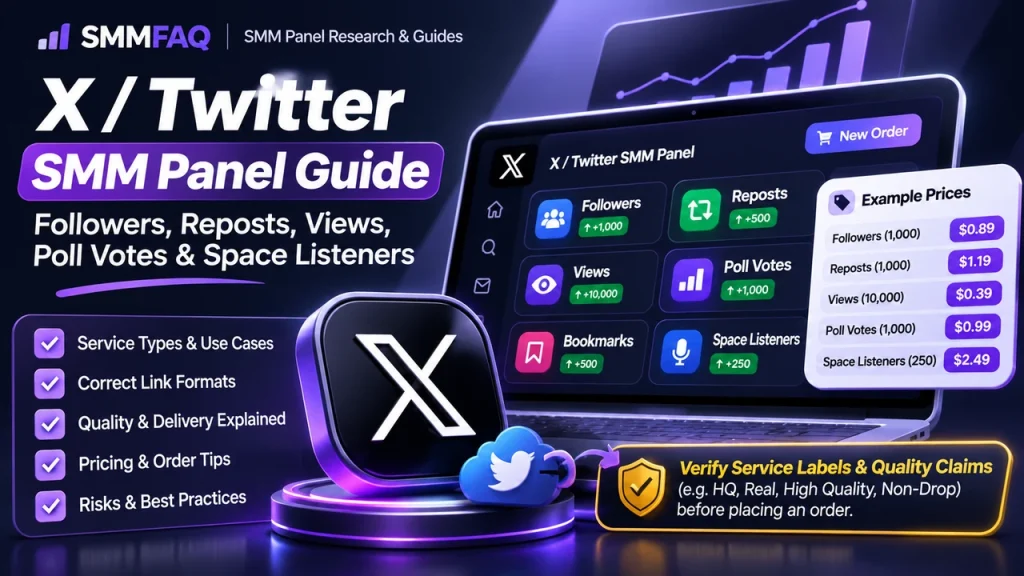
X—still commonly called Twitter in SMM catalogs—has one of the broadest and fastest-changing service menus. Followers and likes are only the beginning; current catalogs also list reposts, replies, bookmarks, poll votes, impressions, profile clicks, link clicks and live Space listeners.
The Main X / Twitter SMM Service Types
| Service | Target | What changes |
|---|---|---|
| Followers | Profile | Follower count |
| Likes | Post | Like count |
| Reposts | Post | Repost count |
| Replies | Post | Reply/comment count |
| Views / impressions | Post/video | Visible or measured exposure metric |
| Bookmarks | Post | Bookmark count where available |
| Poll votes | Active poll | Selected poll option |
| Space listeners | Live Space | Live listener count / duration |
A public SMM Center snapshot dated October 4, 2026 listed 384 X services across 13 categories. That breadth is useful evidence that “Twitter SMM panel” is not one product; it is a cluster of distinct metrics.
Followers
Follower rows vary by refill, targeting, start time and account quality labels. A profile URL or username is usually required. A follower order should not be evaluated using the same price benchmark as a view or repost service because the supply and risk are different.
Likes, Reposts and Replies
These are post-level metrics. A like service expects a post link; a repost service changes redistribution; a reply service adds written responses and may be custom or provider-generated. Custom text introduces the same formatting issues covered in Custom Comments in SMM Panels.
Views and Impressions
Panels sometimes use “views” and “impressions” loosely. Check the service description to see whether it refers to video views, post views or an impression-style counter. Similar naming does not guarantee identical measurement.
Poll Votes
Poll-vote services are time-sensitive because the poll must still be open. The order may require the post URL and a selected option. A visible vote count should not be treated as evidence of genuine public opinion.
Bookmarks
Bookmark services are a newer, thinner category than followers or likes. Because public catalog supply is smaller, pricing can be more volatile and descriptions less standardized. Check whether the provider counts a bookmark action per account or sells a packaged service.
Space Listeners
Space listener services target live audio rooms. They are usually duration-based, similar in structure to live-viewer products on Twitch or TikTok. A service that promises 500 listeners for 30 minutes should be compared with another 30-minute product, not with a permanent follower service.
Why X Supply Changes Quickly
The X ecosystem has changed substantially since the Twitter rebrand. Provider sources can disappear, account pools can be removed, and automation costs or API conditions can change. That is one reason old “best Twitter SMM service” advice can become stale quickly.
SMMFAQ recommends recording the service ID, date, rate, refill and max quantity when researching an X service, because the same row can change later.
Reading Labels: HQ, Real, ND and R30
X service names frequently combine platform metric and seller-defined quality labels. A row called “USA Followers | HQ | R30 | 10K/D” contains targeting, quality, refill and speed claims. Decode those parts separately using SMM Panel Service Labels Explained.
Correct Link Formats
- Profile followers → profile URL or username as specified.
- Likes/reposts/replies/bookmarks → exact post URL.
- Video views → post/video URL accepted by the provider.
- Poll votes → poll post while it is open.
- Space listeners → current live Space URL or supported identifier.
If the panel rejects the target, use SMM Panel Invalid Link Error rather than repeatedly submitting a different service.
Platform Authenticity Risk
X publishes authenticity rules covering inauthentic behavior and manipulation of platform features. A catalog listing does not override those rules. Buyers and resellers should treat service availability and platform compliance as separate questions.
How to Compare X Services
- Compare the same metric.
- Match targeting and refill.
- Match duration for live products.
- Check min/max and start time.
- Check whether the label is a claim or a structured field.
- Review current platform rules.
- Use recent data because X supply changes quickly.
How a X / Twitter Order Moves Through an SMM Panel
From the customer side, the order looks simple: choose a service, submit the target and quantity, then watch the status. Behind the panel, the row can be mapped to an upstream provider through an API. The provider validates the profile, post, poll or live Space target, creates its own external order and returns a status to the reseller.
Because each layer can rename services or normalize statuses differently, the customer-facing order ID does not necessarily reveal the upstream source. This is why SMMFAQ recommends saving the local service ID and date rather than relying only on a service name.
Worked Example
Suppose you compare two X follower rows. Record profile URL, baseline followers, refill, country label and service date. For a separate Space-listener test, record the live Space URL, duration and concurrent listener target; do not combine those results with follower retention.
The purpose of the example is not to recommend a quantity. It shows which fields should be recorded so the result can be audited later: target, quantity, service ID, start time, visible baseline, final status and any duration/refill terms.
Common Failure Modes
- Post or poll is deleted/closed
- Wrong target type
- Space ends before delivery completes
- Reply text is filtered
- Provider account pool is removed
- Service definition changes after an X platform update
A failed or Partial order does not automatically mean the panel is fraudulent. It can reflect target validation, upstream capacity, platform changes or a service-specific rule. Repeated failures across unrelated categories are more significant than one isolated order.
How to Compare Two Services Without Comparing Apples to Oranges
- Exact metric
- Profile/post/Space target
- Duration for Space listeners
- Refill for followers
- Custom vs provider-written replies
- Country/quality labels
- Current catalog date
Price becomes meaningful only after those fields match. A cheaper listing can be a different product—shorter duration, no refill, different targeting, smaller maximum or a different traffic/account source.
What Panel Operators and Resellers Should Monitor
X catalogs change quickly, so resellers should keep last-sync timestamps and disable unavailable rows rather than leaving stale service names active. Specialized metrics such as polls and Spaces should have clear descriptions.
For operators using provider APIs, an automatic sync should not blindly publish every upstream row. High-risk or time-sensitive service types benefit from manual descriptions that explain target format, duration and customer-side restrictions.
What the Visible Metric Does Not Prove
Followers, views, reposts, bookmarks, replies and Space listeners are different counters. None by itself proves authentic audience interest, commercial intent or campaign success.
This is the central research distinction between a metric and an outcome. A visible counter can be measured; authenticity, intent, conversion and long-term business value require different evidence.
Post-Order Audit
- Save the final status and timestamp.
- Compare the visible metric with the pre-order baseline.
- Check whether any promised duration/refill window is still active.
- Record unexpected drops or removals.
- Do not start an overlapping replacement order until the first order is final.
- If support is needed, send exact order data rather than a vague complaint.
Research Framework for X / Twitter Services
X catalogs combine stable long-standing metrics such as followers with thinner products such as bookmarks, poll votes and Space listeners. A research page should show which categories have deep supply and which are niche.
A useful SMMFAQ comparison separates what is directly observable from what is only claimed. Observable fields include the published rate, minimum, maximum, visible service type, refill/cancel flags and the time the row was captured. Claims such as “real,” “premium,” “stable,” or “best quality” require additional evidence and should be stored as labels rather than facts.
1. Normalize the Unit Before Comparing Price
Normalize followers, likes and reposts per 1,000 only when the targeting and refill match. Space listeners require duration normalization. Replies can be custom-text products and may need per-comment context rather than a generic rate comparison.
This normalization is important for search users as well as resellers. A Google result that says one panel is ‘cheapest’ can be misleading when the products use different units, duration or scope. SMMFAQ therefore prefers comparable service definitions over headline floor prices.
2. Separate Quality Claims From Remedy Terms
Country, HQ, real and non-drop labels are claims. A refill period is a remedy term. For custom replies, text quality is another independent dimension.
A refill window is measurable as a policy field. A quality label is descriptive. They can appear together, but neither should silently substitute for the other. If a provider advertises both, record both.
3. Treat Timing as Part of the Product
Poll services expire when the poll closes; Space listeners expire when the Space ends; ordinary follower delivery is not tied to a live window. Timing therefore changes by metric.
For time-sensitive metrics, the start-time claim can be more important than the maximum throughput. For long-running follower/member products, later retention or refill may matter more. This is why one generic ‘speed’ score is usually too simplistic.
4. Save Evidence for Support
Save the canonical X post/profile/Space URL, selected poll option if relevant, and current service description. X URLs and naming conventions can change over time, so the captured target matters.
Good troubleshooting is data-driven. A support ticket containing service ID, order ID, target, pre-order baseline, relevant timestamps and screenshots is much easier to investigate than a message that only says “not working.”
5. Compare the Service With the Wider Panel Context
A single good or bad row does not describe an entire panel. Use the service-label guide and other SMMFAQ research pages to compare provider behavior, catalog changes and panel availability before drawing panel-wide conclusions.
A Note on Historical Names
Many searchers still use “Twitter SMM panel” even though the platform is now X. Good research content should use both names naturally so older service catalogs, URLs and user queries remain understandable. The naming change itself does not tell you whether an old provider row is still active; check the current target format and last update date.
Frequently Asked Questions
What services do X/Twitter SMM panels sell?
Common categories include followers, likes, reposts, views, replies, bookmarks, poll votes, impressions, profile clicks, link clicks and Space listeners.
Are reposts and quote posts the same?
No. A repost republishes a post, while a quote post adds commentary. SMM panels may list them as separate services.
What are Space listeners?
They are live-audio audience services for X Spaces and are commonly sold by quantity and duration.
Why do X services change so often?
Supply can be affected by platform enforcement, API changes, account availability and provider source changes.
Does a service labeled ‘real’ prove genuine interest?
No. ‘Real’, ‘HQ’ and similar labels are seller-defined claims, not independent verification of user intent.