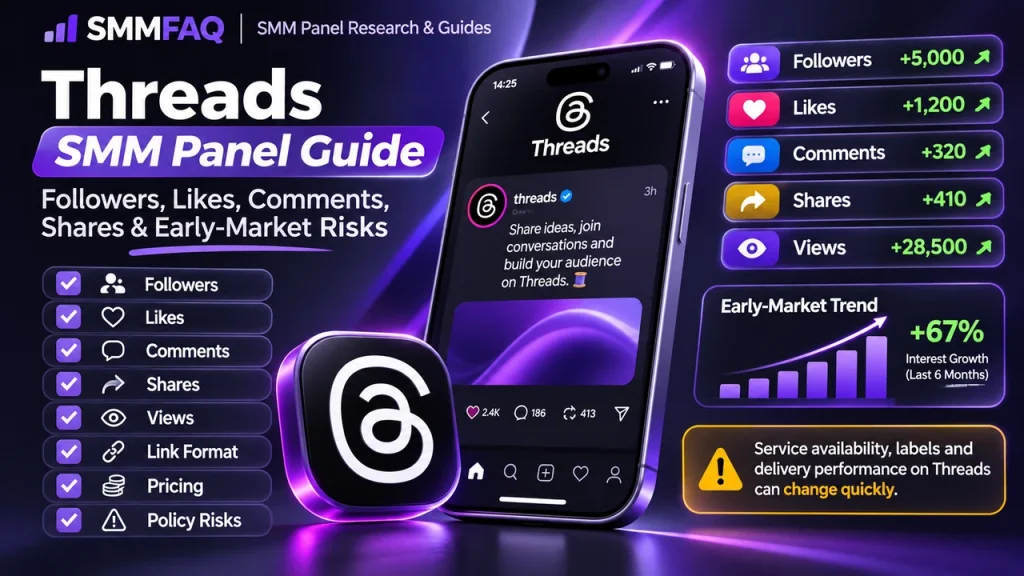
Threads is now large enough to support a distinct SMM service market, but the catalog is still less mature than Instagram or TikTok. That creates an unusual combination: hundreds of panels list followers, likes, comments and shares, while some metrics still have thin supply and fast-changing prices.
What Threads SMM Panels Sell
| Service | Target | Current market depth |
|---|---|---|
| Followers | Profile | Large |
| Likes | Post | Large |
| Comments | Post | Large |
| Shares/reposts | Post | Moderate-large |
| Views | Post/content where supported | Smaller |
Current Market Snapshot
IntelSMM reported more than 2,100 Threads follower services across 521 panels in November 2026. It also tracked 1,511 like services from 462 panels, 1,433 comment services from 325 panels, 959 share services from 349 panels and a much smaller view category.
That imbalance is important: a mature follower category can have stronger price competition than a thin feature such as views.
Threads Followers
Follower services target the profile count. Provider descriptions may include HQ, Real, refill or country labels, but these are seller-defined. A Threads follower service should be compared with another Threads follower service with similar refill and targeting—not with Instagram followers.
Likes
Likes are post-level. The exact Threads post must remain public and accessible. A profile URL is not a substitute. Because likes are a simpler action than written comments, they generally have deeper supply and lower prices than comment services.
Shares / Reposts
Threads terminology and product naming can evolve as the platform changes. Some panels may call the action a share, repost or reshare. Confirm the actual metric the row is designed to change instead of relying on the label alone.
Views and Thin-Supply Metrics
When a service category has fewer providers, prices can move more quickly and definitions can be less consistent. A low number of view rows compared with followers is a signal to read descriptions carefully and avoid assuming every panel supports the metric.
Threads vs Instagram
Threads is connected to Meta’s ecosystem, but it is not simply an Instagram subcategory. A Threads URL, Threads profile and Threads post should be treated as separate targets. Sending an Instagram URL to a Threads service can produce a validation error.
Why Early-Market Pricing Is Volatile
Newer catalog categories have fewer stable provider routes. When one large source changes price or disappears, many reseller panels can update at once. This can move market medians faster than in older categories.
For service-source context, read How Do SMM Panels Get Their Services?.
Labels and Refill
Threads rows use the same general SMM shorthand as other platforms: HQ, R30, Non-Drop, Instant and per-day speed limits. Those labels remain provider claims. Decode them with SMM Panel Service Labels Explained.
Correct Links
- Followers → Threads profile URL/username format accepted by provider.
- Likes/comments/shares → exact Threads post URL.
- Do not substitute an Instagram post URL.
- Check whether shortened/share URLs are accepted.
- If rejected, copy the canonical current URL.
Policy and Authenticity Context
Threads operates under Meta’s broader integrity and community systems. A visible metric increase does not establish genuine interest, and Meta can remove inauthentic or spam-like activity. Treat panel availability and platform compliance as separate questions.
How to Compare Threads Services
- Match the exact metric.
- Use current data because the market moves quickly.
- Compare refill and targeting separately.
- Check whether comments are custom or random.
- Check min/max and start time.
- Treat market medians as context, not quality scores.
How a Threads Order Moves Through an SMM Panel
From the customer side, the order looks simple: choose a service, submit the target and quantity, then watch the status. Behind the panel, the row can be mapped to an upstream provider through an API. The provider validates the Threads profile/post target, creates its own external order and returns a status to the reseller.
Because each layer can rename services or normalize statuses differently, the customer-facing order ID does not necessarily reveal the upstream source. This is why SMMFAQ recommends saving the local service ID and date rather than relying only on a service name.
Worked Example
Imagine two follower services with similar prices but different refill labels and maximums. Record the profile URL, baseline count and service date because the category is still changing quickly. For comments or shares, use a separate post-level test rather than assuming follower quality predicts engagement-service behavior.
The purpose of the example is not to recommend a quantity. It shows which fields should be recorded so the result can be audited later: target, quantity, service ID, start time, visible baseline, final status and any duration/refill terms.
Common Failure Modes
- Instagram URL submitted instead of Threads URL
- Provider row removed in a fast-changing market
- Post deleted or visibility changed
- Comment text filtered
- Follower source loses accounts
- Service naming changes after platform feature updates
A failed or Partial order does not automatically mean the panel is fraudulent. It can reflect target validation, upstream capacity, platform changes or a service-specific rule. Repeated failures across unrelated categories are more significant than one isolated order.
How to Compare Two Services Without Comparing Apples to Oranges
- Followers vs likes/comments/shares
- Profile vs post target
- Refill and quality label
- Current market date
- Min/max
- Custom vs random comments
- Price volatility
Price becomes meaningful only after those fields match. A cheaper listing can be a different product—shorter duration, no refill, different targeting, smaller maximum or a different traffic/account source.
What Panel Operators and Resellers Should Monitor
For Threads, frequent catalog snapshots are valuable because the market is less mature. Resellers should keep historical rates and availability rather than overwriting every prior observation during sync.
For operators using provider APIs, an automatic sync should not blindly publish every upstream row. High-risk or time-sensitive service types benefit from manual descriptions that explain target format, duration and customer-side restrictions.
What the Visible Metric Does Not Prove
A larger follower count does not prove post reach; likes do not prove comments; comments do not prove unique customers; and a new platform’s fast-growing service market does not establish stable long-term quality.
This is the central research distinction between a metric and an outcome. A visible counter can be measured; authenticity, intent, conversion and long-term business value require different evidence.
Post-Order Audit
- Save the final status and timestamp.
- Compare the visible metric with the pre-order baseline.
- Check whether any promised duration/refill window is still active.
- Record unexpected drops or removals.
- Do not start an overlapping replacement order until the first order is final.
- If support is needed, send exact order data rather than a vague complaint.
Research Framework for Threads Services
Threads is an early-market SMM category with deep follower/like supply but thinner specialized metrics. Rapid service creation and removal make update timestamps unusually important.
A useful SMMFAQ comparison separates what is directly observable from what is only claimed. Observable fields include the published rate, minimum, maximum, visible service type, refill/cancel flags and the time the row was captured. Claims such as “real,” “premium,” “stable,” or “best quality” require additional evidence and should be stored as labels rather than facts.
1. Normalize the Unit Before Comparing Price
Compare follower rows per 1,000 only after matching refill and targeting. Comment prices should be separated by custom vs random text. Thin view categories should be treated cautiously because a few providers can shift the market median.
This normalization is important for search users as well as resellers. A Google result that says one panel is ‘cheapest’ can be misleading when the products use different units, duration or scope. SMMFAQ therefore prefers comparable service definitions over headline floor prices.
2. Separate Quality Claims From Remedy Terms
Real, HQ and country labels remain claims. A refill window is a concrete policy field. The younger market makes it especially important not to promote labels as established quality standards.
A refill window is measurable as a policy field. A quality label is descriptive. They can appear together, but neither should silently substitute for the other. If a provider advertises both, record both.
3. Treat Timing as Part of the Product
Follower orders can be relatively slow or fast without a content deadline, while post interactions depend on the target remaining public. Timing also matters when a provider row disappears quickly.
For time-sensitive metrics, the start-time claim can be more important than the maximum throughput. For long-running follower/member products, later retention or refill may matter more. This is why one generic ‘speed’ score is usually too simplistic.
4. Save Evidence for Support
Save the canonical Threads profile/post URL, baseline metric, service ID, last-updated date and service name. This creates a historical record if the provider changes the row later.
Good troubleshooting is data-driven. A support ticket containing service ID, order ID, target, pre-order baseline, relevant timestamps and screenshots is much easier to investigate than a message that only says “not working.”
5. Compare the Service With the Wider Panel Context
A single good or bad row does not describe an entire panel. Use the SMM supply-chain guide and other SMMFAQ research pages to compare provider behavior, catalog changes and panel availability before drawing panel-wide conclusions.
Why Historical Price Tracking Helps
In a young market, one provider change can move many reseller prices at once. Keeping weekly or monthly snapshots helps distinguish a genuinely broad market trend from one temporary cheap source. It also makes older “cheapest Threads panel” articles easier to audit because readers can see when the quoted rate was measured.
Current data matters more than old rankings.
Frequently Asked Questions
What Threads services do SMM panels sell?
Common catalog types include followers, likes, comments, shares/reposts and, in a smaller number of catalogs, views or other engagement metrics.
Are Threads services the same as Instagram services?
No. Threads and Instagram are linked within Meta’s ecosystem, but their public metrics, URLs and service rows are separate.
Why do Threads prices change quickly?
The market is newer and supply is thinner for some metrics, so provider availability and pricing can move more sharply than mature categories.
What link should I use for Threads services?
Follower services usually target a Threads profile; post-level likes, comments or shares use the specific Threads post URL accepted by the provider.
Does a Threads follower service guarantee real engagement?
No. A follower count is one metric and does not prove comments, clicks, conversions or authentic interest.
Comments
Comments add visible text and therefore introduce language, content and moderation issues. Custom-comment services should be separated from provider-written/random comments. For input rules, see Custom Comments in SMM Panels.