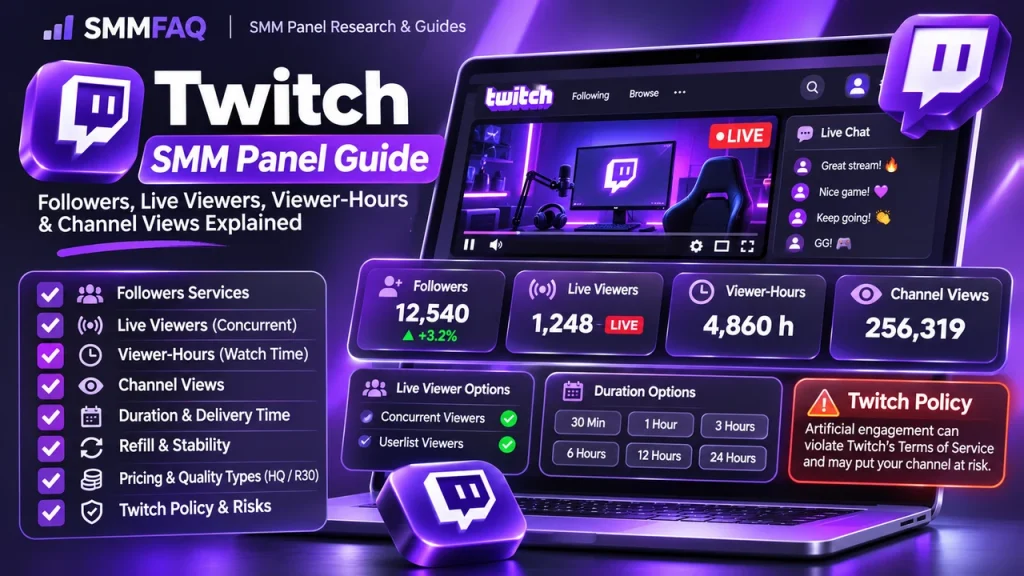
Twitch SMM catalogs mix several metrics that look similar but measure different things: followers, concurrent live viewers, viewer-hours, channel views, VOD views and sometimes a visible userlist. Understanding those units is more important than comparing the cheapest rate.
Twitch Followers, Live Viewers and Viewer-Hours Are Different
| Metric | What it represents | Typical SMM unit |
|---|---|---|
| Followers | Accounts following the channel | Per 1,000 |
| Live viewers | Concurrent audience during a stream | Per 1,000 + duration |
| Viewer-hours | Audience multiplied by time | Hours/package |
| Channel/VOD views | Recorded view counters | Per 1,000 |
| Userlist viewers | Accounts visible in chat/userlist style products | Duration/package |
Concurrent Live Viewers
A live-viewer service aims to raise the viewer count while a stream is live. Because the metric is concurrent, time matters. A service may advertise 5, 15, 30 or 60 minutes, while another may offer multi-hour durations.
If a streamer orders 1,000 viewers for 15 minutes, that is not equivalent to 1,000 followers or 1,000 channel views. The quantity describes the simultaneous audience target and the duration describes how long the provider attempts to maintain it.
Viewer Count vs Users in Chat
Twitch officially distinguishes the viewer count from the list of users connected to chat. Someone can be watching without appearing as a logged-in chat user, and a user can be connected to chat without actively viewing the stream.
This matters because some SMM rows advertise “userlist” or “chat list” presence. That is not proof that the same number is being counted by Twitch as concurrent viewers.
Viewer-Hours
Viewer-hours combine quantity and time. A simplified example is 100 viewers maintained for one hour = 100 viewer-hours; 500 viewers for two hours = 1,000 viewer-hours. A provider can package this differently, so read the service description rather than assuming a universal formula.
Market Snapshot
SMM Index reported 469 panels listing Twitch live-viewer services in a November 2026 snapshot, with a median published rate of about $14.78 per 1,000 for the category it tracked. The same market contained much cheaper short-duration listings, which shows why rate comparisons need to include duration and service type.
A 5-minute viewer product and a one-hour stable-viewer product should not be compared only by the per-1,000 number.
Twitch Followers
Follower services change a different metric and are not time-based in the same way. Twitch warns that follow-botting and view-botting are forms of fake engagement. It also notes that fake batches can be removed, producing sudden follower drops.
Twitch Policy Risk
Twitch’s official help documentation states that artificial inflation of channel statistics—such as views or follows—through third-party tools is fake engagement. Twitch says users who participate in or organize these services can face enforcement up to indefinite suspension.
Twitch also says it does not punish a broadcaster for botting caused by another party when the broadcaster is not responsible. This distinction matters when interpreting sudden suspicious viewer or follower activity.
How to Read a Twitch SMM Service Name
A row such as “Twitch Live Viewers | 15 Minutes | Userlist | Instant | Max 10K” contains several separate attributes: metric, duration, userlist claim, start-time claim and maximum quantity. Use the Service Labels guide to decode shorthand.
What to Check Before Comparing Twitch Services
- Is it followers, concurrent viewers, VOD/channel views or viewer-hours?
- What is the duration?
- Does the row claim userlist presence?
- What is the maximum concurrent quantity?
- Is the start time realistic for a live event?
- Does the provider disclose refill or drop behavior?
- What platform-policy risk applies?
Correct Target and Timing
Live-viewer orders are time-sensitive. The stream must be live and the provider must receive a target it can resolve. Ordering before the stream exists, using an old VOD link, or confusing a channel URL with a live URL can cause delay or failure.
If a provider rejects an otherwise valid URL, see SMM Panel Invalid Link Error.
Why a Viewer Spike Is Not the Same as Audience Growth
Concurrent viewer count is one momentary metric. It does not by itself create chat participation, repeat viewers, followers, subscriptions or community retention. A high visible count can therefore coexist with low real engagement.
For research, treat the SMM service as a metric product and separately evaluate the platform’s rules and the business value of the metric.
How a Twitch Order Moves Through an SMM Panel
From the customer side, the order looks simple: choose a service, submit the target and quantity, then watch the status. Behind the panel, the row can be mapped to an upstream provider through an API. The provider validates the live stream/channel target, creates its own external order and returns a status to the reseller.
Because each layer can rename services or normalize statuses differently, the customer-facing order ID does not necessarily reveal the upstream source. This is why SMMFAQ recommends saving the local service ID and date rather than relying only on a service name.
Worked Example
Consider a 200-viewer, 30-minute test on a live stream. Record the Twitch channel URL, the baseline concurrent count, the moment the order starts, the highest observed count and the time viewers begin to fall away. Do not mix that result with follower or channel-view changes.
The purpose of the example is not to recommend a quantity. It shows which fields should be recorded so the result can be audited later: target, quantity, service ID, start time, visible baseline, final status and any duration/refill terms.
Common Failure Modes
- Stream is not live when provider starts
- Wrong channel/VOD target
- Duration shorter than expected
- Viewer count and userlist do not match
- Twitch filters artificial engagement
- Provider cannot maintain requested concurrency
A failed or Partial order does not automatically mean the panel is fraudulent. It can reflect target validation, upstream capacity, platform changes or a service-specific rule. Repeated failures across unrelated categories are more significant than one isolated order.
How to Compare Two Services Without Comparing Apples to Oranges
- Concurrent quantity
- Duration
- Start time
- Userlist claim
- Maximum viewers
- Policy risk
- Price per viewer-minute rather than only per 1,000
Price becomes meaningful only after those fields match. A cheaper listing can be a different product—shorter duration, no refill, different targeting, smaller maximum or a different traffic/account source.
What Panel Operators and Resellers Should Monitor
For live-viewer products, store duration as a first-class field. A 5-minute row and a 60-minute row should never share the same customer-facing comparison without the duration being visible.
For operators using provider APIs, an automatic sync should not blindly publish every upstream row. High-risk or time-sensitive service types benefit from manual descriptions that explain target format, duration and customer-side restrictions.
What the Visible Metric Does Not Prove
Twitch itself distinguishes viewer count from users in chat. Neither number proves community engagement, subscriptions or returning viewers. Artificial engagement can also be filtered or enforced against under Twitch policy.
This is the central research distinction between a metric and an outcome. A visible counter can be measured; authenticity, intent, conversion and long-term business value require different evidence.
Post-Order Audit
- Save the final status and timestamp.
- Compare the visible metric with the pre-order baseline.
- Check whether any promised duration/refill window is still active.
- Record unexpected drops or removals.
- Do not start an overlapping replacement order until the first order is final.
- If support is needed, send exact order data rather than a vague complaint.
Research Framework for Twitch Services
Twitch live products require a different research model from static social metrics. A current catalog can contain dozens of duration variants for what appears to be the same live-viewer service, plus follower and VOD/channel-view products.
A useful SMMFAQ comparison separates what is directly observable from what is only claimed. Observable fields include the published rate, minimum, maximum, visible service type, refill/cancel flags and the time the row was captured. Claims such as “real,” “premium,” “stable,” or “best quality” require additional evidence and should be stored as labels rather than facts.
1. Normalize the Unit Before Comparing Price
For live viewers, compare price per viewer-minute or at least match the same duration. A $1/1K five-minute listing is not cheaper than a $3/1K one-hour listing in any simple sense. Followers and channel views use different units altogether.
This normalization is important for search users as well as resellers. A Google result that says one panel is ‘cheapest’ can be misleading when the products use different units, duration or scope. SMMFAQ therefore prefers comparable service definitions over headline floor prices.
2. Separate Quality Claims From Remedy Terms
Labels such as stable, userlist or high quality are provider claims. Duration is measurable. Twitch policy risk is also separate from the catalog claim and should be stated explicitly.
A refill window is measurable as a policy field. A quality label is descriptive. They can appear together, but neither should silently substitute for the other. If a provider advertises both, record both.
3. Treat Timing as Part of the Product
A service that starts 25 minutes late on a 30-minute broadcast has almost no useful delivery window. Live-event timing should therefore be measured from order submission to first observed change.
For time-sensitive metrics, the start-time claim can be more important than the maximum throughput. For long-running follower/member products, later retention or refill may matter more. This is why one generic ‘speed’ score is usually too simplistic.
4. Save Evidence for Support
Record the channel, stream start time, order time, provider start time, maximum observed concurrent count and end time. Without those timestamps, a live-viewer dispute is difficult to reconstruct.
Good troubleshooting is data-driven. A support ticket containing service ID, order ID, target, pre-order baseline, relevant timestamps and screenshots is much easier to investigate than a message that only says “not working.”
5. Compare the Service With the Wider Panel Context
A single good or bad row does not describe an entire panel. Use the small-order testing guide and other SMMFAQ research pages to compare provider behavior, catalog changes and panel availability before drawing panel-wide conclusions.
Frequently Asked Questions
What is the difference between Twitch live viewers and channel views?
Live viewers are concurrent viewers watching a live stream at a moment in time. Channel or VOD views are different counters and should not be compared directly.
What are Twitch viewer-hours?
Viewer-hours combine audience size and time. For example, 100 concurrent viewers maintained for one hour equals roughly 100 viewer-hours.
Does Twitch count chat users as viewers?
Not necessarily. Twitch officially distinguishes the current viewer count from users connected to chat; a chat user may not be watching the video.
Are Twitch SMM viewers allowed by Twitch?
Twitch states that artificial inflation of viewers, chat activity or followers is fake engagement and can lead to enforcement when the streamer is responsible.
Why are live-viewer services sold by duration?
Concurrent viewers must remain connected during the stream. Providers therefore commonly sell 5-minute, 15-minute, 1-hour or longer duration windows.