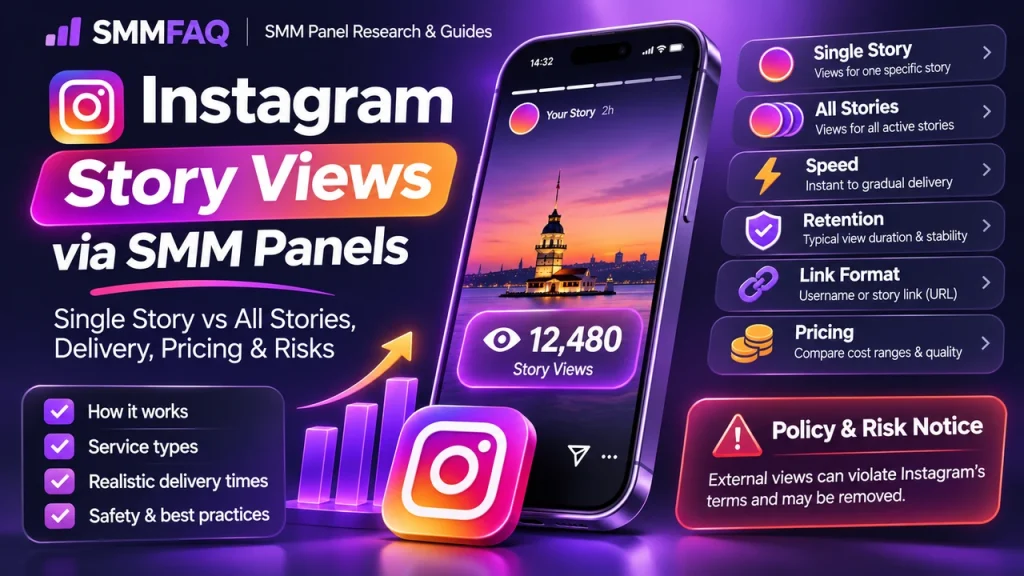
Instagram Story Views are a separate SMM category from Reel views, video views and profile visits. The service is also unusually time-sensitive because a standard Story has a limited active window. That makes target format, start time and “single vs all stories” wording especially important.
Why Start Time Matters
Story content is temporary. A service that starts several hours late may deliver only part of the intended quantity before the story is no longer active. For Story Views, queue time can matter more than a very high advertised daily speed.
Profile Username vs Story Link
Some providers ask for the Instagram username and automatically find active stories. Others accept a direct story/profile URL. If the selected row expects a username, pasting a Reel or post link can trigger Invalid Link.
Use SMM Panel Invalid Link Error when a target opens in your browser but is rejected by the provider.
Market Snapshot: November 2026
IntelSMM reported 7,751 Instagram Story View service listings across 621 panels on November 4, 2026. Its observed median was $0.32 per 1,000, while the published market contained extreme low-price outliers.
That spread is a reminder that “cheapest” is not a service definition. The same market includes All Stories, no-refill, instant-start and different daily-capacity labels.
Why Median Is More Useful Than the Lowest Rate
An extremely cheap listing can be a limited source, temporary row, unusual bundle or low-capacity product. A median price gives better context for the middle of a dataset, but even the median cannot tell you quality or delivery behavior.
For the broader method, see SMM Price Index 2026.
Story Views vs Reel Views vs Video Views
Reels and normal video posts remain accessible after a Story would normally expire. Their view services therefore have different operational constraints. A Reel view row should not be used as a substitute just because it is cheaper.
Speed Labels
Story catalogs often use “Instant,” “10K–50K/day,” or “Always/All Stories.” Decode start and throughput separately. Instant start does not guarantee instant completion, and a high daily cap does not matter if the story expires before the queue begins.
Retention and Refill
Story-view services are usually not evaluated like long-term follower retention because the content itself is temporary. If a row advertises refill, confirm exactly what the provider means and whether the story must remain active.
Pre-Order Checklist
- Story is active and public enough for the service.
- Single vs All Stories is understood.
- Target format matches username/link requirement.
- Start-time claim fits remaining Story lifetime.
- Quantity interpretation is clear.
- No overlapping Story-view service is running.
- Service ID and timestamp are saved.
Policy and Analytics Context
Visible Story views are one metric and should not be treated as verified unique customers, qualified leads or sales. Meta can also remove inauthentic activity under its integrity systems. A third-party panel cannot guarantee that every delivered view will remain or be treated as authentic engagement.
How to Compare Services
Match service scope first, then start time, quantity interpretation, max, price and seller labels. Compare single-story to single-story and all-stories to all-stories. Use SMM Panel Service Labels Explained for shorthand such as Instant, ND, HQ or 50K/D.
How a Instagram Story Order Moves Through an SMM Panel
From the customer side, the order looks simple: choose a service, submit the target and quantity, then watch the status. Behind the panel, the row can be mapped to an upstream provider through an API. The provider validates the active Story/profile target, creates its own external order and returns a status to the reseller.
Because each layer can rename services or normalize statuses differently, the customer-facing order ID does not necessarily reveal the upstream source. This is why SMMFAQ recommends saving the local service ID and date rather than relying only on a service name.
Worked Example
Suppose a profile has three active Stories and you test an ‘All Stories’ row for 1,000 views. Before ordering, record how many Story items are active and what the provider says 1,000 means. After delivery, inspect each item separately instead of assuming the total was distributed evenly.
The purpose of the example is not to recommend a quantity. It shows which fields should be recorded so the result can be audited later: target, quantity, service ID, start time, visible baseline, final status and any duration/refill terms.
Common Failure Modes
- Story expires before delivery
- Provider targets only the latest Story
- Username/profile is private or changed
- Direct story URL is unsupported
- All-Stories quantity interpretation differs
- Provider queue starts too late
A failed or Partial order does not automatically mean the panel is fraudulent. It can reflect target validation, upstream capacity, platform changes or a service-specific rule. Repeated failures across unrelated categories are more significant than one isolated order.
How to Compare Two Services Without Comparing Apples to Oranges
- Single vs All Stories
- Quantity per story vs total
- Start time
- Remaining Story lifetime
- Username vs direct link
- Daily capacity
- Price per 1,000
Price becomes meaningful only after those fields match. A cheaper listing can be a different product—shorter duration, no refill, different targeting, smaller maximum or a different traffic/account source.
What Panel Operators and Resellers Should Monitor
Story products should include scope—single, all active, automatic/new stories—as a structured attribute. This reduces support disputes about whether the quantity was meant for one item or every item.
For operators using provider APIs, an automatic sync should not blindly publish every upstream row. High-risk or time-sensitive service types benefit from manual descriptions that explain target format, duration and customer-side restrictions.
What the Visible Metric Does Not Prove
A Story view counter does not prove unique people, conversion, profile visits or interest. Temporary visibility also makes long-term retention concepts less meaningful than start time and correct targeting.
This is the central research distinction between a metric and an outcome. A visible counter can be measured; authenticity, intent, conversion and long-term business value require different evidence.
Post-Order Audit
- Save the final status and timestamp.
- Compare the visible metric with the pre-order baseline.
- Check whether any promised duration/refill window is still active.
- Record unexpected drops or removals.
- Do not start an overlapping replacement order until the first order is final.
- If support is needed, send exact order data rather than a vague complaint.
Research Framework for Instagram Story View Services
Story services combine a temporary target with ambiguous scope labels such as single, all, always or automatic. A useful comparison must capture how many active Story items existed when the order was placed.
A useful SMMFAQ comparison separates what is directly observable from what is only claimed. Observable fields include the published rate, minimum, maximum, visible service type, refill/cancel flags and the time the row was captured. Claims such as “real,” “premium,” “stable,” or “best quality” require additional evidence and should be stored as labels rather than facts.
1. Normalize the Unit Before Comparing Price
For single-story rows, price per 1,000 is straightforward. For all-stories products, determine whether the quantity applies per Story or across the sequence before calculating an effective rate.
This normalization is important for search users as well as resellers. A Google result that says one panel is ‘cheapest’ can be misleading when the products use different units, duration or scope. SMMFAQ therefore prefers comparable service definitions over headline floor prices.
2. Separate Quality Claims From Remedy Terms
Story-view labels such as HQ or real are claims. Because the content expires, start-time reliability and scope are often more operationally important than long refill terminology.
A refill window is measurable as a policy field. A quality label is descriptive. They can appear together, but neither should silently substitute for the other. If a provider advertises both, record both.
3. Treat Timing as Part of the Product
The remaining lifetime of the Story is the real deadline. A high daily speed is irrelevant if the provider waits too long to begin.
For time-sensitive metrics, the start-time claim can be more important than the maximum throughput. For long-running follower/member products, later retention or refill may matter more. This is why one generic ‘speed’ score is usually too simplistic.
4. Save Evidence for Support
Save the profile/story target, number of active Story items, order timestamp and visible count on each Story. This helps identify whether an all-stories service covered every item.
Good troubleshooting is data-driven. A support ticket containing service ID, order ID, target, pre-order baseline, relevant timestamps and screenshots is much easier to investigate than a message that only says “not working.”
5. Compare the Service With the Wider Panel Context
A single good or bad row does not describe an entire panel. Use the SMM Price Index methodology and other SMMFAQ research pages to compare provider behavior, catalog changes and panel availability before drawing panel-wide conclusions.
Frequently Asked Questions
What is the difference between single-story and all-stories services?
Single-story services target one active story item. All-stories services are marketed to send views across multiple active stories or the current story sequence, depending on the provider.
Do Instagram Story views work after the story expires?
No. Standard stories expire from public viewing after their active window, so delivery is time-sensitive unless the provider explicitly supports another format.
What link does a Story Views service need?
Some services use the profile username and target active stories automatically; others require a story or profile link. Follow the exact service description.
Are Story Views the same as Reel views?
No. Story views are tied to temporary Story content. Reel views are video views on Reels and have different link and counting behavior.
Does a higher Story view count prove unique viewers?
Not necessarily. The public metric and third-party delivery should not be treated as verified audience identity or purchase intent.