YouTube Shorts views became more complicated to compare in 2026 because YouTube changed how public views are counted while keeping monetization and eligibility tied to qualified or engaged metrics. That makes the difference between a visible view count and a monetizable view especially important.
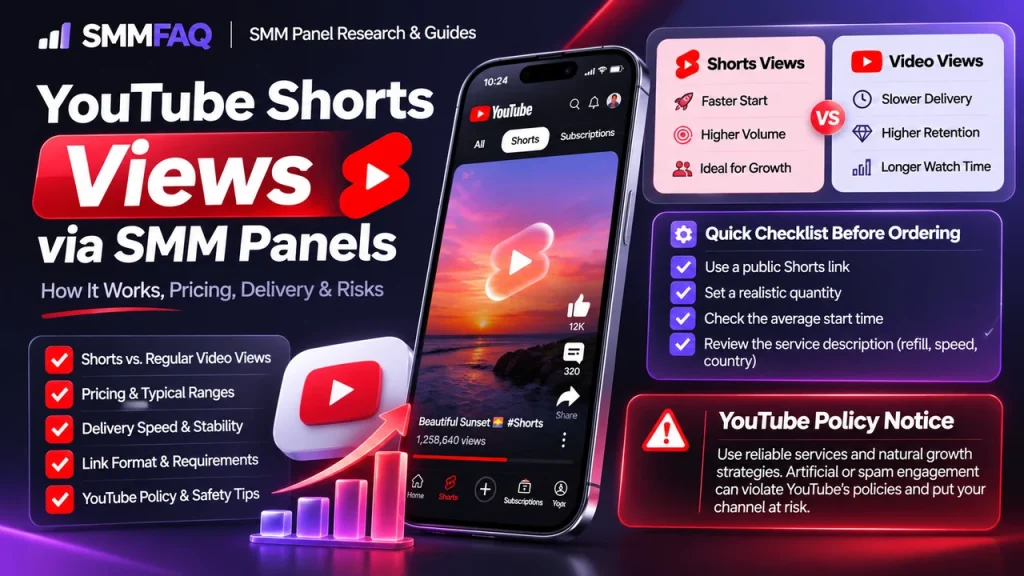
Shorts Views vs Regular Video Views
Both are YouTube views, but the content format, traffic source and provider service can differ. Some panel rows explicitly say “Shorts only,” while others support both Shorts and long-form links. An ordinary video-view service should not be assumed to support Shorts unless the description says so.
YouTube’s August 24, 2026 View-Counting Change
YouTube says that beginning August 24, 2026, views are counted when a video starts to play across Shorts, long-form videos and live streams. However, YouTube also says the change does not alter YPP earnings or eligibility, which still rely on engaged watch hours or qualified views.
This distinction is central to SMM research: a public view count and a qualified monetization metric are not the same dataset.
Current Market Snapshot
IntelSMM reported 2,836 YouTube Shorts View service listings across 507 panels in early November 2026. Its observed median was $2.25 per 1,000, with a lower quartile around $1.41 and a large spread between low and high catalog prices.
The same dataset includes provider labels such as AdWords/Ads, non-drop, refill and speed claims. Those labels describe different product characteristics and should not be collapsed into one price comparison.
What Does ‘Shorts AdWords Views’ Mean?
Some panel catalogs use labels such as AdWords, Google Ads or ad-sourced views. That is a seller description of the delivery source. It should not be read as a guarantee that the view is eligible for revenue, YPP thresholds or any particular analytics classification.
Qualified Views and Monetization
YouTube’s Shorts monetization documentation says artificial or fake views—such as automated click or scroll bots—are ineligible for Shorts revenue calculations. YouTube’s channel monetization policies also prohibit artificially inflating views, subscribers, likes, watch time or ad impressions.
Therefore a panel service should never be marketed as a guaranteed shortcut to YPP eligibility.
Correct Link Format
A Shorts service normally needs the direct Short/video URL. Providers can accept different YouTube URL variants, but a channel homepage is not the same target. If the panel rejects the link, review SMM Panel Invalid Link Error.
Speed, Start Time and Refill
Shorts catalogs include fast-start rows, 1–3K/day rows, larger ad-delivery ranges and refill claims. A higher rate can reflect a different source or service guarantee. Compare start time, delivery capacity, min/max and refill before price.
Use SMM Panel Service Labels Explained for R30, ND, Instant and per-day abbreviations.
Why Public Views Can Change After Delivery
YouTube says it continuously verifies engagement metrics and may slow, freeze, adjust or discard low-quality playbacks. That means a public count can be revised after the initial increase.
Shorts Views vs Watch Hours
Shorts view services and long-form watch-hour services solve different metrics. Public Shorts views should not be converted into “4,000 watch hours” math. For that separate topic, read YouTube Watch Hours via SMM Panels.
Pre-Order Research Checklist
- Confirm Shorts support in the service description.
- Use the exact public Short URL.
- Check source labels such as Ads/AdWords separately.
- Compare start time and daily speed.
- Do not assume public views are YPP-qualified.
- Review YouTube fake-engagement policy.
- Save the service ID and date because catalog rows change.
How to Compare Prices Responsibly
The observed market median is a useful context point, not a quality ranking. A $0.30 ad-labeled row and a $3.00 slower refill row may be completely different products. Normalize by service type before drawing a conclusion.
How a YouTube Shorts Order Moves Through an SMM Panel
From the customer side, the order looks simple: choose a service, submit the target and quantity, then watch the status. Behind the panel, the row can be mapped to an upstream provider through an API. The provider validates the public Short/video target, creates its own external order and returns a status to the reseller.
Because each layer can rename services or normalize statuses differently, the customer-facing order ID does not necessarily reveal the upstream source. This is why SMMFAQ recommends saving the local service ID and date rather than relying only on a service name.
Worked Example
Suppose you test a 1,000-view Shorts row. Record the public view count before ordering, the service source label, start time and the date. After delivery, distinguish the public view change from anything shown in the Earn tab or YPP milestones because YouTube applies separate qualification logic.
The purpose of the example is not to recommend a quantity. It shows which fields should be recorded so the result can be audited later: target, quantity, service ID, start time, visible baseline, final status and any duration/refill terms.
Common Failure Modes
- Short URL format unsupported
- Service only supports long-form video
- Views are verified/adjusted later
- Provider source changes
- Daily-speed cap causes slow delivery
- Artificial views are excluded from monetization metrics
A failed or Partial order does not automatically mean the panel is fraudulent. It can reflect target validation, upstream capacity, platform changes or a service-specific rule. Repeated failures across unrelated categories are more significant than one isolated order.
How to Compare Two Services Without Comparing Apples to Oranges
- Shorts-specific support
- Public view delivery
- Source label such as Ads
- Start/daily speed
- Refill claim
- Observed market price
- YPP/qualified-view distinction
Price becomes meaningful only after those fields match. A cheaper listing can be a different product—shorter duration, no refill, different targeting, smaller maximum or a different traffic/account source.
What Panel Operators and Resellers Should Monitor
For YouTube products, reseller descriptions should never promise monetization eligibility unless the provider can legitimately establish that under YouTube’s rules—which third-party view delivery generally cannot guarantee. Keep public metric and monetization claims separate.
For operators using provider APIs, an automatic sync should not blindly publish every upstream row. High-risk or time-sensitive service types benefit from manual descriptions that explain target format, duration and customer-side restrictions.
What the Visible Metric Does Not Prove
A public Shorts view is not automatically a qualified YPP view, engaged view, subscriber, watch-hour contribution or revenue event. YouTube explicitly applies additional verification and eligibility rules.
This is the central research distinction between a metric and an outcome. A visible counter can be measured; authenticity, intent, conversion and long-term business value require different evidence.
Post-Order Audit
- Save the final status and timestamp.
- Compare the visible metric with the pre-order baseline.
- Check whether any promised duration/refill window is still active.
- Record unexpected drops or removals.
- Do not start an overlapping replacement order until the first order is final.
- If support is needed, send exact order data rather than a vague complaint.
Research Framework for YouTube Shorts View Services
Shorts research has to separate the public view counter from YouTube’s qualified and engaged metrics. The 2026 counting change makes that distinction even more important because a public view can appear earlier while YPP systems apply separate verification.
A useful SMMFAQ comparison separates what is directly observable from what is only claimed. Observable fields include the published rate, minimum, maximum, visible service type, refill/cancel flags and the time the row was captured. Claims such as “real,” “premium,” “stable,” or “best quality” require additional evidence and should be stored as labels rather than facts.
1. Normalize the Unit Before Comparing Price
Compare Shorts-specific rows with the same source type, start speed and refill. Ads-labeled and non-ads-labeled rows should not be mixed into one cheapest-price ranking without noting the source claim.
This normalization is important for search users as well as resellers. A Google result that says one panel is ‘cheapest’ can be misleading when the products use different units, duration or scope. SMMFAQ therefore prefers comparable service definitions over headline floor prices.
2. Separate Quality Claims From Remedy Terms
Non-drop, lifetime refill and real views are seller claims or policies; YPP qualification is a YouTube determination. Do not let a service label imply a monetization result.
A refill window is measurable as a policy field. A quality label is descriptive. They can appear together, but neither should silently substitute for the other. If a provider advertises both, record both.
3. Treat Timing as Part of the Product
Shorts can accumulate views quickly, but provider delivery may be capped per day. Record the initial public count and recheck after YouTube has had time to verify metrics.
For time-sensitive metrics, the start-time claim can be more important than the maximum throughput. For long-running follower/member products, later retention or refill may matter more. This is why one generic ‘speed’ score is usually too simplistic.
4. Save Evidence for Support
Save the Short URL, public view baseline, order ID, delivery timestamps and the exact source/refill label. Do not use the Earn tab as if it should mirror the public counter in real time.
Good troubleshooting is data-driven. A support ticket containing service ID, order ID, target, pre-order baseline, relevant timestamps and screenshots is much easier to investigate than a message that only says “not working.”
5. Compare the Service With the Wider Panel Context
A single good or bad row does not describe an entire panel. Use the YouTube Watch Hours guide and other SMMFAQ research pages to compare provider behavior, catalog changes and panel availability before drawing panel-wide conclusions.
Frequently Asked Questions
Are YouTube Shorts views counted the same as long-form video views?
YouTube changed public view counting in August 2026 so a view is counted when playback starts across formats, but YPP earnings and eligibility still rely on engaged or qualified metrics.
Do SMM Shorts views count toward monetization?
Do not assume so. YouTube says artificial or fake Shorts views are ineligible for revenue calculations, and YPP uses qualified/engaged metrics rather than every public view.
What link should a Shorts view service use?
Use the public Shorts/video URL format accepted by the provider. A channel URL is not a substitute for a specific Shorts target.
Why are some Shorts services labeled AdWords or Ads?
Some providers market paid-ad sourced views separately from other delivery sources. The label should be verified in the service description and should not be assumed to guarantee YPP eligibility.
Are Shorts views cheaper than regular views?
Sometimes, but the market varies by source, speed, refill and delivery method. Compare equivalent product types rather than the platform label alone.