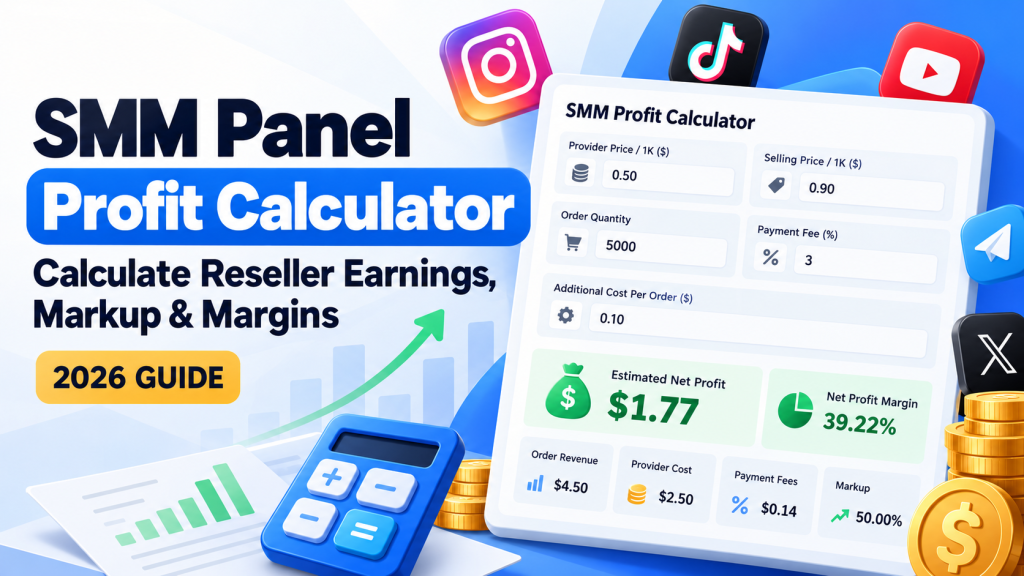
Running an SMM panel business involves more than buying services at a low price and reselling them at a higher rate. Provider costs, payment processing fees, refunds, operational expenses, and pricing changes can all affect your actual earnings.
Our free SMM panel profit calculator helps resellers estimate their earnings based on service costs, selling prices, order quantities, and additional expenses.
Whether you manage an SMM reseller panel, operate a digital services business, or compare wholesale SMM providers, understanding the difference between revenue, profit, markup, and margin is essential.
In this guide, you will learn how to calculate SMM reseller profits, evaluate pricing strategies, and avoid common financial mistakes.
Free SMM Panel Profit Calculator
Use the interactive calculator below to estimate your reseller earnings.
The calculator includes:
- Provider cost per 1,000 units
- Customer selling price per 1,000 units
- Order quantity
- Payment processing fee percentage
- Additional fixed costs per order
- Estimated net profit
- Profit margin and markup percentage
- Break-even selling price
Enter your figures to see how changing a service rate affects your estimated earnings.
SMM Reseller Profit Calculator
Enter your provider rate, selling price and order costs.
Estimates only. Assumes proportional pricing and a payment fee based on customer revenue. Taxes, refunds and unentered operating costs are excluded.
Note: Calculations are estimates based on the information you enter. They do not represent guaranteed earnings, live provider quotations, or professional financial advice.
What Is an SMM Panel Profit Calculator?
An SMM panel profit calculator is an online tool designed to estimate how much money an SMM reseller could earn after purchasing services from an upstream provider and selling them to customers.
Most SMM panels display their service prices per 1,000 units, commonly called the price per 1K.
For example, a reseller may purchase a hypothetical service at $0.50 per 1,000 units and offer it to customers at $0.80 per 1,000 units.
The difference is $0.30 per 1,000 units before additional expenses.
However, that difference is not necessarily the reseller’s actual net profit.
Payment fees, support costs, unexpected fulfillment expenses, refunds, taxes, and other business overhead may reduce earnings.
This is why using a profit calculator is more useful than simply subtracting the provider rate from the selling rate.
For additional pricing context, read Why Do SMM Panel Prices Differ?.
How to Calculate SMM Panel Reseller Profit
To calculate reseller profit accurately, start with four basic values: provider rate, selling rate, order quantity, and additional expenses.
Step 1: Determine Your Provider Cost
Your provider cost is the price charged by the upstream supplier.
Imagine a hypothetical service listed at $0.50 per 1,000 units.
For an order of 5,000 units:
Provider Cost = (5,000 / 1,000) × $0.50 = $2.50
Remember that advertised prices may change and some providers use minimum billing rules.
Step 2: Calculate Customer Revenue
Suppose your reseller panel sells the same quantity at $0.90 per 1,000 units.
Revenue = (5,000 / 1,000) × $0.90 = $4.50
This represents the customer-facing order charge, not your profit.
Step 3: Deduct Additional Expenses
Assume your payment processor charges 3% of the transaction and your additional allocated expense is $0.10.
Payment fee:
$4.50 × 3% = $0.135
Estimated net profit before taxes:
$4.50 − $2.50 − $0.135 − $0.10 = $1.765
Rounded to cents, your estimated profit is $1.77.
This example assumes successful delivery, proportional provider billing, and no additional refunds or charges.
SMM Panel Profit Calculation Example
The following table demonstrates how a reseller’s earnings can change with different selling prices.
All examples use a hypothetical 5,000-unit order, a provider rate of $0.50 per 1K, a 3% transaction fee, and a $0.10 additional expense.
| Selling Price / 1K | Revenue | Provider Cost | Estimated Net Profit |
|---|---|---|---|
| $0.60 | $3.00 | $2.50 | $0.31 |
| $0.80 | $4.00 | $2.50 | $1.28 |
| $1.00 | $5.00 | $2.50 | $2.25 |
| $1.20 | $6.00 | $2.50 | $3.22 |
These figures are illustrative and are not live prices from SMMFAQ’s synchronized service database.
Actual reseller pricing must consider service characteristics and provider conditions, not simply the lowest available rate.
Explore the SMMFAQ Services Database to research service listings, price-per-1K information, limits, and available service features.
SMM Panel Markup vs Profit Margin: What’s the Difference?
Markup and profit margin are not interchangeable.
Markup measures the percentage added to the underlying cost.
Profit margin measures profit as a percentage of customer revenue.
Consider a simplified example:
- Provider cost: $1.00
- Customer selling price: $1.50
- Gross profit: $0.50
- Markup: 50%
- Gross profit margin: 33.33%
A reseller applying a 50% markup does not automatically earn a 50% profit margin.
The difference becomes even more important after processing fees and other operating expenses.
The calculator above shows both markup and estimated net profit margin so you can evaluate the same order from different financial perspectives.
How to Set SMM Reseller Prices
There is no universal markup percentage suitable for every SMM panel service.
A responsible pricing strategy should consider several factors.
Provider Rates
The upstream provider rate determines your initial fulfillment expense. Compare equivalent services rather than relying only on similar names.
Transaction Costs
Payment processing fees reduce the amount retained from each customer payment. Fixed transaction fees can have a particularly large effect on small orders.
Refunds and Order Adjustments
Canceled, partial, or failed orders may require financial adjustments. The amount refunded by your supplier might differ from the amount returned to your customer.
Support and Maintenance
Hosting, API synchronization, customer support, security, and payment management all involve operating costs.
Service Characteristics
Two services displaying the same type of engagement may differ in supported quantities, refill eligibility, cancellation availability, targeting, and delivery conditions.
You can learn more from How to Compare SMM Panels Using Real Data.
Why the Cheapest Provider Is Not Always the Most Profitable
It may seem logical that a lower provider price always produces a higher profit.
But comparing only rates ignores operational risk.
For example, a low-cost service that frequently requires manual intervention could generate higher support expenses than a more predictable alternative.
A service with changing availability may also cause delays or customer complaints.
Resellers should evaluate price together with service limits, documented terms, order outcomes, and supplier communication.
The SMMFAQ guide to SMM provider supply chains explains why providers, aggregators, and resellers can display different rates for services that appear similar.
How API Automation Affects Reseller Profitability
Many SMM businesses use APIs to synchronize service catalogs, submit orders, check statuses, and process supported refill or cancellation requests.
Automation can reduce repetitive administrative work, but it also introduces operational considerations.
For example, your provider might change a service price while your reseller panel still displays the previous rate.
If your software does not update the retail price or alert you to changes, the margin could shrink or become negative.
A practical API-based pricing workflow should consider:
- Monitoring provider price changes.
- Recalculating customer-facing rates when appropriate.
- Checking minimum and maximum quantities.
- Handling canceled and partially delivered orders.
- Recording actual provider charges.
- Comparing expected and realized profit.
For more technical background, read What Is an SMM Panel API?.
How to Calculate Monthly SMM Panel Earnings
Once you understand earnings per order, you can create a basic monthly estimate.
Suppose your average estimated net profit is $0.40 per successful order.
| Completed Orders / Month | Estimated Monthly Profit |
|---|---|
| 100 | $40 |
| 500 | $200 |
| 1,000 | $400 |
| 5,000 | $2,000 |
These estimates assume the same average profit per order and do not establish demand, expected customer growth, or a guaranteed business outcome.
If you have recurring expenses such as website hosting, staff, software subscriptions, or accounting, those costs also need to be deducted when calculating overall business profit.
A useful approach is to maintain records of actual orders, supplier charges, refunds, transaction expenses, and realized monthly results.
Common SMM Panel Pricing Mistakes
Confusing Revenue with Profit
A large number of customer payments does not automatically mean the business is profitable.
Revenue must be reduced by supplier charges and other expenses.
Forgetting Payment Processing Fees
A service with a narrow markup can become unprofitable after transaction expenses.
Ignoring Provider Price Updates
A supplier’s rate can change after a service has been imported into a reseller catalog.
Setting the Same Markup for Every Service
Different service categories may involve different costs and operational requirements.
Treating Estimated Earnings as Guaranteed
Theoretical margins do not account for every refund, dispute, failed order, or market change.
Overlooking Platform Risks
Purchased or artificially generated engagement may violate social platform rules and should not be confused with authentic audience growth, legitimate advertising, or meaningful conversions.
Frequently Asked Questions
How do I calculate SMM panel profit?
Multiply the order quantity by your selling rate per 1,000 units to calculate revenue. Subtract the provider charge, transaction fees, and additional expenses to estimate net profit.
Is the SMM panel profit calculator free?
Yes. The calculator on this page is available for free and does not require users to submit orders or connect a provider API.
What is a good profit margin for an SMM reseller?
There is no universally suitable margin. It depends on supplier costs, payment fees, refunds, overhead, competition, and the services offered.
What is the difference between markup and profit margin?
Markup compares the price increase against cost, while profit margin compares profit against revenue. A 50% markup on a $1.00 cost creates a $1.50 selling price and a 33.33% gross margin before other expenses.
Can I calculate profit using price per 1K?
Yes. For services using proportional pricing, multiply the price per 1K by the order quantity divided by 1,000.
Does the calculator use live SMM provider prices?
No. The calculator uses the figures entered by the visitor. You can independently research available service rates using the SMMFAQ Service Comparison Database.
Can API resellers use this calculator?
Yes. API resellers can enter the upstream price and their customer-facing rate to estimate per-order earnings. For accurate business reporting, they should reconcile those estimates with actual API charges and accounting records.
Final Thoughts
An SMM panel profit calculator can help resellers make better pricing decisions by showing the financial difference between supplier cost, customer revenue, markup, and actual expenses.
Rather than assuming every low-priced service is profitable, calculate the expected outcome using realistic cost assumptions.
Use the calculator on this page to test your numbers, then visit the SMMFAQ Services Database to compare available service information.
SMMFAQ focuses on service research, provider comparisons, and educational resources to help readers understand the economics and operational limitations of the SMM panel industry.