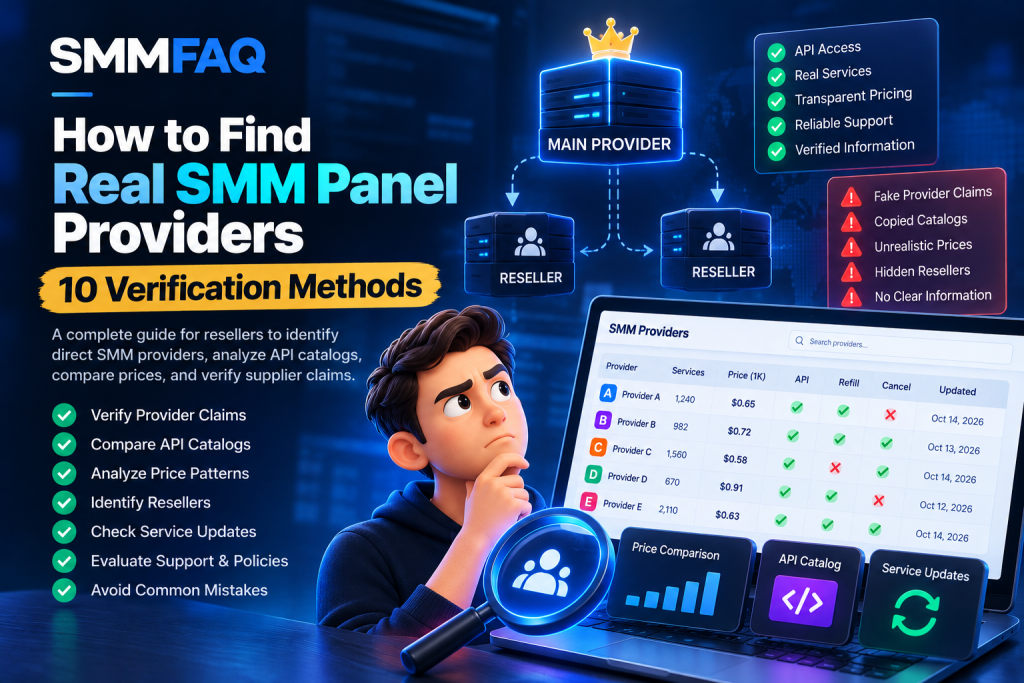
Finding a real SMM panel provider is one of the most frequently discussed challenges among SMM panel owners, resellers, and API users.
Thousands of websites advertise themselves as direct providers, main suppliers, or wholesale SMM platforms. Many offer similar Instagram, TikTok, YouTube, Telegram, and other social media services.
But how do you know whether an SMM panel operates its own services or simply resells another provider’s catalog?
More importantly, does working directly with a service source always mean lower prices and better performance?
The answer is more complicated than most promotional websites suggest.
Quick answer: There is no universal method for identifying the original provider behind every SMM service. However, resellers can investigate supplier claims through API documentation, catalog patterns, price histories, service specialization, update behavior, support policies, and independently verifiable business information. These methods help assess credibility, but none alone proves direct ownership of a service.
In this guide, we examine 10 practical verification methods for researching SMM panel providers in 2026, explain misleading industry claims, and demonstrate how structured comparison data can support better research decisions.
What Is a Real SMM Panel Provider?
A real SMM provider is generally understood as a business that directly supplies a service, rather than merely forwarding orders to another reseller.
However, the term provider has different meanings across the industry.
A company may operate certain services internally while sourcing others through external suppliers.
Another may aggregate multiple sources and offer their services through a single API.
Consider three simplified models:
Direct supply model
Service Source → Customer
Reseller model
Service Source → API Provider → Reseller → Customer
Aggregator model
Multiple Sources → Aggregator → Reseller → Customer
These are illustrative supply chains. Real relationships may involve additional intermediaries.
The main distinction is between the organization fulfilling a particular service and the company selling access to it.
An API provider is not necessarily the original fulfillment source.
For a detailed introduction, see What Is an SMM Panel Provider?.
Why Is Finding a Direct SMM Provider Difficult?
The SMM market contains overlapping supplier relationships.
A single reseller may import services from several upstream APIs, rename the listings, and set its own retail prices.
Another panel may use one of those resellers as its primary supplier.
As a result, the same underlying service may appear on several websites under different names, prices, and service IDs.
It is also possible for two unrelated providers to publish similar-looking services.
This creates two important problems:
- Similarity does not establish common sourcing.
- Different prices do not establish different sourcing.
A June 2025 Reddit discussion explored the difficulty of finding a single original main provider. The author argued that supply is fragmented across services and platforms.
Source: Reddit – Let’s Find the Main Provider for SMM Panel Services.
The discussion reflects one industry participant’s perspective, not an independently verified map of all providers.
Nevertheless, it highlights why searching for one universal wholesale source may be less useful than investigating providers at the individual service level.
10 Ways to Verify an SMM Panel Provider
1. Examine the Provider’s Service Specialization
Start by looking at the categories a provider offers.
Some suppliers concentrate on a particular platform, target market, or service type.
Others maintain broad catalogs covering many social networks.
Specialization can offer useful context because different services may require different operational relationships and technical infrastructure.
For example, one hypothetical supplier might concentrate on YouTube-related services while another publishes an extensive multi-platform catalog.
However, neither specialization nor catalog breadth proves whether a company is a direct source.
A direct supplier may operate several service categories.
An aggregator may specialize in a single category.
What to verify:
- Supported platforms
- Service categories
- Geographic markets
- Published service limitations
- Documented operational capabilities
- Evidence supporting claims of direct fulfillment
Research conclusion: Treat specialization as a clue about business focus, not proof of provider ownership.
2. Compare API Service Catalogs
A provider’s API catalog can reveal useful structural information.
Many SMM APIs expose fields such as:
| API Field | What It Describes |
|---|---|
service | Provider-assigned service identifier |
name | Service name |
category | Service category |
rate | Advertised rate |
min | Minimum quantity |
max | Maximum quantity |
refill | Advertised refill support |
cancel | Advertised cancellation support |
Consider two hypothetical service records.
Provider A
{
  "service": 201,
  "name": "Instagram Followers",
  "rate": "0.65",
  "min": "100",
  "max": "50000",
  "refill": true,
  "cancel": false
}
Provider B
{
  "service": 9042,
  "name": "Instagram Followers HQ",
  "rate": "0.85",
  "min": "100",
  "max": "50000",
  "refill": true,
  "cancel": false
}
These listings share several attributes.
However, they could represent the same upstream service, unrelated services, or two listings from a shared aggregator.
The available information is not enough to establish which explanation is correct.
Catalog comparison becomes more informative when multiple unusual characteristics match across numerous services and over time.
For technical background, read What Is an SMM Panel API?.
3. Analyze Price Patterns Over Time
Price comparison is another useful research method.
A direct provider is sometimes assumed to offer the lowest available rate.
That assumption is not always correct.
A large reseller may negotiate wholesale pricing, accept lower margins, or operate a more efficient billing structure.
For example:
| Supplier | Hypothetical Price / 1K |
|---|---|
| Provider A | $0.60 |
| Provider B | $0.72 |
| Reseller C | $0.58 |
The lowest price belongs to Reseller C.
This does not establish that Reseller C owns the service or that its service is equivalent to the other listings.
To investigate pricing relationships, compare:
- Price changes over several dates
- Currency conversion differences
- Service quantity limits
- Refill and cancellation conditions
- Similar catalog descriptions
- Timing of availability changes
Some online discussions claim that unusual decimal prices reveal a reseller markup.
That is not a reliable standalone test.
Any business can use fractional prices, and a direct provider can choose whatever lawful pricing structure suits its operation.
Research conclusion: Price movements can suggest commercial relationships, but a particular price format does not prove reseller status.
For structured price research, visit the SMMFAQ Service Comparison Database.
4. Compare Service IDs and Description Patterns
Service IDs are used to identify products within an API catalog.
They are useful for technical recordkeeping, but they are not universal identifiers.
Two providers might use identical IDs for completely unrelated services.
Likewise, a reseller may assign a new internal ID when importing an upstream service.
Descriptions offer another comparison point.
For example, two listings might share:
- An unusual service name
- Identical minimum and maximum quantities
- Matching refill conditions
- The same spelling mistakes
- Similar service exclusions
- Identical description updates
A collection of uncommon matches can justify further investigation.
However, copied descriptions are widespread, and shared API software may produce similar catalog structures.
What to verify: Look for multiple independent indicators rather than deciding based on one matching ID or description.
SMMFAQ has a dedicated guide explaining this research process:
How to Tell If Two SMM Panels Use the Same Provider.
5. Track Service Availability and Catalog Updates
Changes in service availability can provide clues about supplier relationships.
Suppose two panels repeatedly:
- Add similar services within the same short period.
- Change their maximum quantities at approximately the same time.
- Suspend comparable listings.
- Restore those listings after similar intervals.
This pattern may indicate a shared upstream dependency.
However, social platform changes can also affect multiple independent suppliers simultaneously.
Therefore, synchronized updates are evidence to investigate, not definitive proof.
A stronger analysis records changes over multiple dates and compares several service attributes.
What to verify:
- Catalog synchronization timestamps
- Service additions and removals
- Minimum and maximum quantity changes
- Refill and cancellation updates
- Category changes
- Price revisions
The SMMFAQ Services Database displays available catalog information, including update context where provided.
A synchronized catalog does not independently verify current service performance or the underlying supply chain.
6. Investigate Provider Business Identity
A supplier’s business information deserves separate attention.
Before establishing a commercial relationship, investigate whether the organization provides meaningful and consistent details about its operations.
Useful information can include:
- Business or legal identity, where disclosed
- Contact and support channels
- Terms of service
- Payment and refund policies
- Privacy and data handling disclosures
- Business history
- Clearly documented contractual conditions
No single website detail guarantees legitimacy.
For example, HTTPS protects information in transit but does not establish that a company operates services directly.
Similarly, an old domain does not prove that the current operator has always controlled it.
Check public business information where available and identify contradictions that require clarification.
Research conclusion: Business transparency is relevant to commercial credibility, but business registration and service-source ownership are different questions.
7. Evaluate API Reliability and Technical Documentation
For resellers, API documentation is a practical part of provider due diligence.
A well-documented API should explain how authorized users can interact with the provider’s system.
Common functions include:
- Retrieve services
- Submit orders
- Check order status
- Retrieve account balance
- Request cancellation when supported
- Request refill when supported
A technical evaluation should also review authentication requirements, error messages, rate limits, and status definitions.
However, having a well-functioning API does not prove that a company owns its upstream fulfillment infrastructure.
A reseller can operate a technically excellent API.
Likewise, a direct source may offer limited documentation.
Key distinction: API reliability measures the integration interface. Service ownership describes the sourcing relationship. Fulfillment reliability concerns whether the promised service is actually delivered.
These three concepts should be assessed separately.
8. Examine Refill, Cancellation, and Support Policies
A supplier’s operational policies may be more useful than its marketing labels.
Before relying on a provider, examine:
- The meaning of each order status
- Eligibility for cancellation
- Refill conditions
- Treatment of partial orders
- Available refund methods
- Support response procedures
- Dispute resolution policies
For example, a service that advertises 30-day refill does not necessarily provide unconditional replacement for all losses.
Eligibility can depend on the applicable service conditions.
Similarly, a cancellation feature does not guarantee that every order can be stopped immediately.
A supplier should explain restrictions clearly enough that resellers can communicate them accurately to their own customers.
Provider transparency is particularly important in multi-layer supply chains because disputes may require several organizations to coordinate.
9. Evaluate Independent Evidence and Customer Reports
Customer experiences can provide helpful research leads.
However, online reviews require careful interpretation.
Reddit discussions about SMM panels often include direct recommendations, referral promotions, anonymous complaints, and claims about original suppliers.
A June 2024 discussion in r/Smm_Panel_Providers examined the differences between main providers and resellers, including price, support, and service stability.
Source: Reddit – Provider, Best & Cheapest SMM Panels: Industry Discussion.
Some participants shared specific provider recommendations, but those recommendations should not be considered independent verification.
When reviewing customer reports, ask:
- Does the reviewer provide relevant context?
- Is there an undisclosed promotional relationship?
- Are the claims specific and independently checkable?
- Do other sources report similar issues?
- Are the reports current?
- Does the business provide a documented response?
Negative and positive experiences can both be genuine without accurately representing overall performance.
Research conclusion: Use community discussions to generate verification questions, not to certify a supplier.
10. Request Verifiable Evidence of Direct Supply
This is the most important step when direct sourcing is a requirement.
Rather than relying on claims such as main provider or original supplier, ask the company to explain which services it fulfills directly.
Possible questions include:
- Which service categories do you operate directly?
- Which categories rely on upstream partners?
- Can you provide evidence supporting your direct-supply claims?
- What happens when an upstream dependency fails?
- Are there written service-level or refund commitments?
- Who is responsible for resolving delivery disputes?
- Can the sourcing relationship be described contractually?
Some providers may decline to disclose commercially sensitive supplier information.
That does not automatically make them fraudulent.
However, if a company cannot substantiate a direct-supply claim, the claim should remain unverified.
Researchers should avoid attempting to access private systems, obtain API credentials without authorization, or investigate infrastructure through intrusive methods.
Research conclusion: Direct supply is best established through trustworthy documentation and authorized evidence, not assumptions based on website appearance.
Which Verification Methods Are Most Useful?
The following table summarizes what each method can and cannot establish.
| Method | Useful Research Signal | Main Limitation |
|---|---|---|
| Service specialization | Business focus | Does not prove ownership |
| API catalog comparison | Structural similarities | Catalogs may be copied |
| Price history | Commercial patterns | Margins and discounts vary |
| Service IDs | Catalog relationships | IDs are not global |
| Update timing | Possible shared dependencies | Market events affect many suppliers |
| Business information | Commercial transparency | Does not prove fulfillment source |
| API documentation | Integration maturity | Resellers can also operate APIs |
| Support and policies | Operational accountability | Statements require verification |
| Customer reports | Recurring experience patterns | Anecdotal and potentially biased |
| Documented direct sourcing | Stronger basis for confirmation | Evidence may be confidential or incomplete |
The strongest approach combines multiple sources of evidence and documents uncertainty explicitly.
A researcher should be willing to conclude that a supplier relationship is unknown when reliable information is unavailable.
Main Provider vs Reseller: Which Is Better?
Neither model is automatically superior.
A direct supplier may offer closer communication with the fulfillment source or more control over a specific service.
A reseller or aggregator may provide a larger catalog, consolidated support, easier billing, or access to several upstream sources.
Consider this simplified comparison:
| Factor | Direct Supplier | Reseller / Aggregator |
|---|---|---|
| Service sourcing | May operate directly | Usually relies on upstream sources |
| Catalog breadth | Varies | Can combine many catalogs |
| Pricing | Not necessarily lowest | May offer negotiated rates |
| API availability | Varies | Often available |
| Customer support | Depends on company | Depends on company |
| Fulfillment reliability | Must be evaluated | Must be evaluated |
| Platform-policy risk | Depends on service methods | Depends on service methods |
The meaningful decision is not simply whether one company calls itself a provider.
It is whether the company can substantiate the claims and commitments relevant to the intended use.
For more background, read How Do SMM Panels Get Their Services?.
How to Research SMM Providers With SMMFAQ
SMMFAQ organizes publicly available and synchronized provider information for research purposes.
Its two most relevant resources are the provider directory and the service comparison database.
Step 1: Explore Provider Profiles
Visit the SMMFAQ Provider Research Directory.
Provider profiles may include information about API availability, service catalog coverage, focus areas, and research dates.
These profiles are research records rather than supplier certifications or rankings.
Step 2: Compare Service Attributes
Open the SMMFAQ Full Services Database.
The service comparison interface includes available fields such as:
- Provider
- Service ID
- Service category
- Price per 1,000
- Minimum and maximum quantity
- Refill support
- Cancel support
- Updated information
These fields allow structured comparison across available catalogs.
Step 3: Identify Questions for Further Verification
Look for meaningful differences or unusual similarities.
For example, two listings may share the same quantity limits and cancellation conditions but display different prices.
That observation may justify closer examination.
It should not be interpreted as proof that both services have the same original source.
Step 4: Review Provider Terms Independently
Before entering a commercial relationship, verify important details through the provider’s own official documentation and authorized communication channels.
SMMFAQ does not independently certify that every listed provider operates its own fulfillment infrastructure.
Its purpose is to make published service information easier to research and compare.
Common Mistakes When Searching for the Cheapest SMM Provider
Mistake 1: Assuming the cheapest panel is the original source
Price does not establish ownership.
Wholesale contracts, discounts, currencies, and margins can all influence final rates.
Mistake 2: Believing every main provider claim
The phrase main provider is not a standardized certification.
It should be treated as an unverified claim until supported by suitable evidence.
Mistake 3: Treating an API as proof of direct fulfillment
An API can forward requests to another supplier.
Technical integration does not establish service ownership.
Mistake 4: Trusting identical service names
Service descriptions can be copied, modified, or independently created.
Multiple matching details may create a research lead, but they are not conclusive proof.
Mistake 5: Ignoring platform compliance and service legitimacy
Even an operationally reliable service may violate the rules of the social platform involved.
Artificially generated engagement can lead to removed metrics, account restrictions, or other enforcement outcomes.
A supplier’s claims about delivery reliability should never be interpreted as a guarantee of platform safety.
For a more complete explanation of industry terminology and supplier models, see the SMM Panel List and Provider Research Guide.
Frequently Asked Questions
How do I find a real SMM panel provider?
Examine API catalogs, pricing histories, service specialization, business information, support policies, and documented sourcing claims. No single public signal definitively identifies the original supplier.
Is a main SMM provider always cheaper?
No. A reseller may offer lower prices through negotiated agreements, reduced margins, or other commercial arrangements.
How can I tell if an SMM panel is a reseller?
Compare available catalog and business evidence, then request clarification from the company. Similar services or the existence of an API alone cannot confirm reseller status.
Can an SMM panel be both a provider and a reseller?
Yes. A business may fulfill some service categories directly and source others through external suppliers.
Does having an API mean an SMM panel is a direct provider?
No. An API enables software integration and automation. It does not establish ownership of the fulfillment system.
Are identical service IDs evidence of a shared provider?
Not on their own. Service IDs are usually local to individual catalogs, and different businesses may use the same identifiers.
What is the difference between an SMM provider and an SMM reseller?
A direct provider is understood to supply the underlying service, while a reseller offers access to services obtained from upstream businesses. In practice, companies can operate both models.
Can SMMFAQ identify the original provider of every service?
No. SMMFAQ helps readers compare published provider and catalog information. The complete supply chain may not be publicly verifiable.
Is a direct SMM provider safer than a reseller?
Not necessarily. Security, reliability, compliance, customer support, and business legitimacy must be evaluated separately. Direct sourcing does not remove the risks associated with artificial engagement.
Final Thoughts: Research the Service, Not Just the Provider Label
Finding a real SMM panel provider in 2026 requires a structured research process.
Terms such as direct provider, main supplier, and wholesale SMM panel can provide useful context, but they are not substitutes for evidence.
A more rigorous investigation examines service-level information, supply-chain transparency, business credibility, API behavior, contract terms, and independently verifiable claims.
Price and catalog size may help narrow the research, but neither establishes ownership or service quality.
For researchers and resellers, the most useful principle is simple:
Compare observable facts, document uncertainty, and avoid treating marketing claims as verified evidence.
To continue your research, explore the SMMFAQ Provider Directory, compare listings through the SMMFAQ Services Database, or review How to Tell If Two SMM Panels Use the Same Provider.
Last reviewed: October 14, 2026.
Editorial note: This article is intended for independent industry research and education. Provider directory inclusion does not constitute endorsement, certification, or independent verification of service ownership or fulfillment performance.