Searching for an SMM panel list sounds simple.
In practice, it is one of the more difficult SMM research tasks.
Thousands of websites describe themselves as:
- SMM panels,
- main providers,
- wholesale providers,
- API providers,
- resellers,
- or SMM marketplaces.
Yet two websites that look almost identical can operate very differently behind the scenes.
One may maintain its own service sources.
Another may resell services from several upstream APIs.
A third may function mostly as an aggregator.
And two panels can even sell the same upstream service at different prices.
That means a useful SMM panel list should not simply contain:
Panel A
Panel B
Panel C
Panel D
It should answer a more important question:
How can these panels actually be compared?
This guide explains how to read an SMM panel list in 2026, which fields matter, how API-based providers work, and why panels such as SMMSOC and SosyalMediyam should be evaluated using service-level data rather than promotional labels alone.
You can also browse the SMMFAQ Provider Directory for provider profiles and use the SMMFAQ Services Database for service-level research.
What Is an SMM Panel List?
An SMM panel list is a directory of websites that provide social media marketing services such as:
- Instagram followers,
- TikTok views,
- YouTube subscribers,
- Telegram members,
- Facebook engagement,
- Spotify plays,
- X followers,
- comments,
- reactions,
- and other social metrics.
Modern SMM directories can contain anywhere from a handful of manually reviewed panels to thousands of indexed domains.
For example, one current comparison site says it tracks more than 11,000 SMM panels and millions of services, while another smaller monitoring platform currently tracks a much narrower group of panels and synchronizes their catalogs through API data. smm.guide
This shows an important distinction:
Not every SMM panel list uses the same methodology.
Some directories collect domains.
Some monitor service APIs.
Some rank popularity.
Some collect reviews.
Some allow paid placements.
Others focus on individual services rather than entire panels.
Why Are There So Many SMM Panels?
The SMM industry has a relatively low technical barrier to entry compared with building a social-media delivery network from scratch.
A reseller can operate a panel by connecting to another provider through an API.
The simplified structure is:
Upstream Provider
↓
API
↓
Reseller Panel
↓
Customer
Another panel might use several upstream sources:
Provider A ─┐
Provider B ─┼→ Panel
Provider C ─┘
And an aggregator can combine hundreds or thousands of services from multiple suppliers.
This is why the number of public SMM panels is much larger than the number of genuinely independent service sources.
For a deeper explanation, read How Do SMM Panels Get Their Services?.
SMM Panel List vs SMM Provider List
These terms are often used interchangeably, but they are not necessarily the same.
SMM panel list
May include:
Direct providers
Resellers
Aggregators
Retail panels
Agency-focused panels
Regional panels
SMM provider list
Usually implies panels that supply services to other resellers through API.
The difficulty is that there is no universal certification defining who is a:
Main Provider
Direct Provider
Original Provider
Many of these labels are self-assigned.
That is why SMMFAQ recommends examining actual technical evidence instead of relying only on the word “provider.”
See What Is an SMM Panel Provider? for the broader distinction.
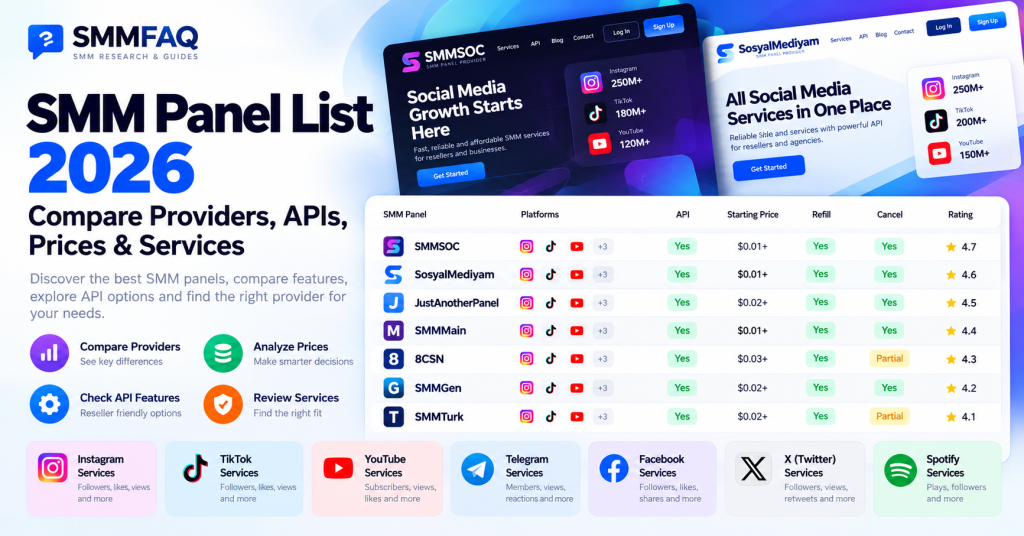
Current SMM Panel Examples in 2026
Below are examples of panels that can be found through current public SMM directories, provider ecosystems or direct API research.
This table is not a ranking.
| Panel | What can be researched | API evidence |
|---|---|---|
| SMMSOC | Multi-platform services, reseller infrastructure | Public /api/v2 |
| SosyalMediyam | Multi-platform services, API ordering | Public /api/v2 |
| JustAnotherPanel | Large established panel appearing in current monitoring datasets | Public-directory presence |
| SMMMain | High-volume panel appearing in current tracking datasets | Public-directory presence |
| 8CSN | Multi-service panel | Public-directory presence |
| SMMGen | Multi-platform panel | Public-directory presence |
| SMMTurk | Regional/global service panel | Public-directory presence |
A September 2026 order-volume study tracked hundreds of panels and included names such as JustAnotherPanel, SMMMain, 8CSN, SMMGen and SMMTurk among the most actively observed domains in its dataset. That dataset measures public order-counter activity, not universal service quality. smm.guide
The difference between appearing on a list and being objectively better is important.
SMMSOC in an SMM Panel List
SMMSOC is an example of a panel with publicly accessible API documentation.
Its current API uses:
POST
https://smmsoc.com/api/v2
and JSON responses. SMMSOC
The service-list response can include:
service
name
type
category
rate
min
max
refill
cancel
This makes SMMSOC particularly useful as an example of why a modern SMM panel list should track structured service data.
Instead of merely saying:
SMMSOC sells Instagram services.
a research database can potentially record:
Exact service
Current price
Minimum
Maximum
Refill support
Cancel support
Category
That produces a much more useful comparison.
SosyalMediyam in an SMM Panel List
SosyalMediyam also exposes a standard SMM API at:
POST
https://sosyalmediyam.com/api/v2
with JSON responses. Sosyalmediyam
Its public documentation demonstrates service fields including:
Service ID
Name
Type
Category
Rate
Min
Max
Refill
Cancel
and also documents order creation through API. Sosyalmediyam
From an SMM research perspective, the interesting point is not simply that:
SMMSOC has API
SosyalMediyam has API
The more useful question is:
How do their individual service catalogs differ?
That is where price, quantity limits, refill, cancellation and service naming become much more useful than a panel-level label.
Why API Support Matters in an SMM Panel List
API support is one of the easiest technical features to verify.
A reseller API usually allows operations such as:
Get services
Create order
Check order status
Check balance
Request refill
Request cancel
depending on the provider.
For example, both SMMSOC and SosyalMediyam publicly document the common /api/v2 SMM API model. SMMSOC
This means an external SMM script can potentially connect directly to them.
A reseller workflow might be:
Customer
↓
Reseller Panel
↓
Provider API
↓
External Order ID
↓
Status Sync
For a technical explanation, see What Is an SMM Panel API?.
Does Having an API Mean a Panel Is a Main Provider?
No.
This is a common misconception.
An API proves that the panel allows software-to-software communication.
It does not automatically prove that the company owns the underlying service infrastructure.
A reseller can expose its own API while purchasing services from another API.
For example:
Provider A
↓
Panel B API
↓
Panel C API
↓
Customer
All three systems could technically expose APIs.
That is why:
Has APIand:
Is original providershould be treated as separate fields.
What Fields Should an SMM Panel List Include?
A useful directory should ideally record more than just the panel name.
Panel-level fields
Panel name
Domain
Country / market
API availability
Supported platforms
Public pricing
Registration status
Last checked
Service-level fields
Service ID
Service name
Category
Rate
Min
Max
Refill
Cancel
Updated
The second group is often more useful.
Why?
Because users buy services, not panel names.
The Problem With “Best SMM Panel List” Articles
Search engines contain thousands of pages with titles like:
Top 10 Best SMM Panels
Best SMM Providers
Cheapest SMM Panel
Top SMM Panel List
The problem is methodology.
Some lists do not explain:
- how panels were selected,
- when prices were checked,
- whether orders were tested,
- whether links are affiliate links,
- whether listings are sponsored,
- or whether the author owns one of the panels.
A current independent testing article, for example, explicitly criticizes lists where placement can be influenced by affiliate commissions and instead describes testing several panels using real orders and measuring delivery, drop rate, refill and support. Blog SMM Panel
That methodology is substantially more useful than:
#1 Panel A
#2 Panel B
#3 Panel C
without supporting data.
A List Is Not the Same as a Ranking
This is an important distinction for SMMFAQ.
An SMM panel list answers:
Which panels exist?
A ranking answers:
Which panel is better than another?
The second requires much stronger evidence.
A directory can objectively show:
Panel A
API: Yes
Services: 2,500
Updated: Today
and:
Panel B
API: Yes
Services: 600
Updated: Yesterday
But those figures alone do not prove:
Panel A > Panel Bbecause Panel B could offer fewer but more specialized services.
Why Service Count Can Be Misleading
Suppose:
Panel A
5,000 services
and:
Panel B
700 services
At first glance, Panel A appears more complete.
But its catalog might contain:
- duplicated services,
- disabled services,
- near-identical variations,
- old services,
- country variants.
Panel B could maintain fewer but more actively managed listings.
Therefore:
Service count is useful context, not a quality score.
Some modern directories therefore track whether service catalogs are actually syncing instead of relying only on advertised counts. One current directory, for example, says it synchronizes panel catalogs and prices via API and displays recent sync times. SMMCollection
What Does “Last Updated” Mean?
SMM catalogs change constantly.
A provider may change:
Price
Min
Max
Refill
Cancel
Service status
without changing the page URL.
For example:
Yesterday
Instagram Followers
$0.50 / 1K
might become:
Today
Instagram Followers
$0.65 / 1K
A static article may still show the old figure.
This is why SMMFAQ places a strong emphasis on data freshness.
How Should Prices Be Compared?
Do not compare only the cheapest listing.
Suppose three panels offer:
| Service | Price / 1K |
|---|---|
| A | $0.08 |
| B | $0.22 |
| C | $0.25 |
Panel A is clearly cheaper.
But perhaps:
A → No refill, max 5K
B → 30D refill, max 500K
C → 90D refill, max 1M
Now the comparison becomes more meaningful.
For more detail, read Why Do SMM Panel Prices Differ?.
Minimum and Maximum Order Size
This is one of the most overlooked fields.
Suppose:
Panel A
$0.10 / 1K
Max: 5,000
and:
Panel B
$0.14 / 1K
Max: 1,000,000
Someone ordering:
500,000cannot use Panel A for a single order regardless of its lower advertised rate.
Therefore a useful list should ideally expose:
Rate + Min + Maxtogether.
Refill Support
Refill can be represented at the individual service level.
SMMSOC and SosyalMediyam both demonstrate this in their public API examples using a Boolean refill field. SMMSOC
For example:
Service 101
Refill: true
does not mean:
Every service on the panel has refill.This distinction matters when directories describe a panel as:
Refill supported.
A more accurate statement is:
The panel contains services with refill support.
Cancel Support
The same principle applies to cancellation.
The API may expose:
cancel: truefor one service and:
cancel: falsefor another. SMMSOC
Therefore:
Cancel should be compared per service, not only per panel.
See What Does Cancel Mean in an SMM Panel? for the mechanics.
Provider vs Reseller vs Aggregator
An SMM panel list becomes much more useful when it distinguishes business models.
Provider
A provider supplies services.
Reseller
A reseller purchases upstream services and applies its own pricing.
Aggregator
An aggregator combines several sources.
A simplified aggregator might look like:
Provider A ──┐
Provider B ──┼── Aggregator
Provider C ──┤
Provider D ──┘
One SMM panel can also use a mixed model.
It may operate some direct services while importing others from API providers.
This is why one label rarely describes every service on the site.
For more context, read What Is an SMM Panel Aggregator?.
How Can You Tell If Two Panels Use the Same Provider?
There are several clues.
Look for identical:
Service names
Min/max values
Rates
Refill periods
Service order
Description text
Price-change timing
For example:
Panel A
Service 500 – Instagram Followers
$0.467
Min 100
Max 50,000
30D refill
and:
Panel B
Service 82 – Instagram Followers
$0.514
Min 100
Max 50,000
30D refill
could potentially share an upstream source.
The different retail price may simply represent markup.
This is not proof by itself, but multiple matching attributes can produce useful evidence.
See How to Tell If Two SMM Panels Use the Same Provider.
Public Pricing Is Valuable
Some SMM panels require registration before prices are visible.
Others display prices publicly.
For research purposes, public pricing is useful because it allows independent monitoring without requiring an account.
One large current directory explicitly includes public pricing as part of its openness methodology. smm.guide
However, public prices still need timestamps.
Otherwise:
Cheap in Januarymay no longer mean:
Cheap in September.How Important Are User Reviews?
Reviews can be useful, but they need context.
A review saying:
Great panel.
provides very little measurable information.
A more useful review might describe:
Service ordered
Quantity
Start time
Completion time
7-day drop
Refill result
Support response
Some modern directories allow users to attach evidence or order screenshots to reviews, which provides more context than a rating alone. smm.guide
Even then, one service experience should not automatically be generalized to the entire catalog.
Why Uptime Matters
For API resellers, panel uptime is especially important.
If the upstream API stops responding:
Customer order
↓
Reseller API
↓
Provider unavailable
↓
Order delayed
A panel can have excellent pricing but still create operational problems if its API or website is frequently unavailable.
Some current SMM directories therefore monitor online status and catalog synchronization as separate signals. smm.guide
A Better SMM Panel List Structure
Instead of:
| Rank | Panel |
|---|---|
| 1 | Panel A |
| 2 | Panel B |
| 3 | Panel C |
a useful directory looks more like:
| Panel | API | Services | Refill | Cancel | Last Checked |
|---|---|---|---|---|---|
| SMMSOC | Yes | Dynamic | Service-level | Service-level | Current research |
| SosyalMediyam | Yes | Dynamic | Service-level | Service-level | Current research |
| Panel C | Yes | Dynamic | Mixed | Mixed | Current research |
| Panel D | No/Unknown | — | — | — | Current research |
This does not try to manufacture a winner.
It gives users comparable information.
SMM Panel List for Instagram
Instagram is usually one of the largest service categories.
A useful Instagram comparison separates:
Followers
Likes
Views
Reels Views
Story Views
Comments
Shares
Saves
rather than labeling everything:
Instagram ServicesSee the SMMFAQ Instagram Services Database for service-level research.
SMM Panel List for TikTok
TikTok panels commonly offer:
Followers
Likes
Views
Shares
Comments
Live services
Again, view pricing and follower pricing should never be merged into one figure.
See TikTok SMM Panel Prices 2026 for the pricing methodology.
SMM Panel List for YouTube
YouTube requires even more segmentation.
A panel can contain:
Subscribers
Standard Views
High Retention Views
Shorts Views
Likes
Comments
Live Viewers
Watch Time
Watch-time services are especially difficult to compare because providers can define units differently.
Use the SMMFAQ YouTube Services Database for current records.
SMM Panel List for Telegram
Telegram catalogs can contain:
Channel Members
Group Members
Views
Reactions
Poll Votes
Premium Members
Boosts
Auto Views
A Telegram view and a Telegram member should never be treated as the same pricing category.
See Telegram SMM Panel Prices 2026 for the broader comparison framework.
Regional SMM Panel Lists
Users also search for:
USA SMM panel list
India SMM panel list
Turkey SMM panel list
UK SMM panel list
Arab SMM panel list
A panel’s operating country and its service targeting should not be confused.
For example:
Panel company location: Turkeydoes not mean:
All services target Turkey.The same panel may sell:
USA Instagram Followers
India TikTok Views
Germany YouTube Views
Global Telegram Members
For broader context, see SMM Panel Prices by Country.
Cheap SMM Panel List: What Does “Cheap” Mean?
A cheap panel can mean at least three different things.
Lowest individual price
Cheapest listing in catalogLowest typical price
Median across comparable listingsLowest wholesale cost
Provider rate before reseller markupThese are different metrics.
A panel advertising:
Services from $0.001may have only one category available at that rate.
That does not mean all services cost approximately $0.001.
Why Median Price Is More Useful Than a Single Minimum
Suppose five comparable services cost:
$0.02
$0.45
$0.48
$0.51
$5.00
The minimum:
$0.02is technically correct.
But the middle of the observed market is around:
$0.48A sophisticated SMM panel list should therefore eventually display:
Lowest
Median
Highest
Listings
Providers
Updated
rather than only:
From $0.02How SMMFAQ Approaches SMM Panel Lists
SMMFAQ’s goal is not to create another static:
Top 10 Panelsarticle.
The research model is built around several layers.
Provider Directory
The SMMFAQ Provider Directory stores panel-level profiles.
Service Database
The SMMFAQ Services Database compares synchronized service-level information.
Editorial Research
Articles explain concepts such as:
- providers,
- APIs,
- refill,
- cancel,
- aggregators,
- supply chains,
- prices.
This structure keeps:
Editorial explanationseparate from:
Current catalog datawhich is important in a market where services change frequently.
What Should Be Checked Before Using Any Panel From a List?
Before funding an account, check at least:
- Does the domain use HTTPS?
- Is the API documented?
- Are prices visible?
- Are min/max quantities clearly shown?
- Does the service indicate refill?
- Is cancel support specified?
- Are terms available?
- Is support contact available?
- When was the information last checked?
- Does the service description match the order type?
- Is the panel currently online?
- Can a small test order be placed first?
This does not guarantee service quality.
It simply produces a better research process.
Should You Trust “Main Provider” Claims?
Treat them as claims unless there is supporting evidence.
Useful evidence might include:
- distinctive services appearing first on one panel,
- downstream panels copying the exact catalog,
- synchronized price changes,
- unique service IDs or descriptions,
- API relationships,
- long-term catalog behavior.
Even then, provider relationships can change.
A service that is direct today could be externally sourced later.
Is a Large SMM Panel Always Better?
No.
Larger catalogs offer more choice.
Smaller panels can offer specialization.
For example:
Panel A
6,000 services
could cover 30 platforms.
Another:
Panel B
200 services
could specialize almost entirely in TikTok.
The correct choice depends on the use case.
A directory should show these differences rather than converting them into a universal quality score.
SMMSOC vs SosyalMediyam: What Can Be Compared Objectively?
Because both publish standard API documentation, several fields can be compared structurally.
| Field | SMMSOC | SosyalMediyam |
|---|---|---|
Standard /api/v2 | Yes | Yes |
| JSON response | Yes | Yes |
| Service IDs | Yes | Yes |
| Rate field | Yes | Yes |
| Min / Max | Yes | Yes |
| Refill field | Yes | Yes |
| Cancel field | Yes | Yes |
Both currently expose the standard service-list structure familiar to SMM reseller software. SMMSOC
What this table does not establish is:
Which one has better services
Which one is cheaper overall
Which one has better retention
Those questions require actual current service datasets.
That is exactly why panel-level lists have limitations.
What Makes an SMM Panel List Useful in 2026?
A useful list should ideally be:
Current
Catalog data should have an update timestamp.
Transparent
The directory should explain where the data comes from.
Service-level
Price and features should be connected to individual listings.
Neutral
Sponsored placements should be clearly separated from research.
Comparable
Users should be able to compare the same service type against another.
Searchable
Thousands of listings require filters.
Static Lists vs Live Databases
A static article might say:
Panel A – 2,000 servicesSix months later:
Panel A – 4,000 servicesbut the article still shows 2,000.
A live database can synchronize the change.
This is especially important for:
Rates
Availability
Refill
Cancel
Min
Max
which can change much faster than panel branding.
Final Thoughts
An SMM panel list is useful as a starting point, but panel names alone provide very little information.
A serious comparison should move through three levels:
Panel
↓
Provider / API structure
↓
Individual service
At the panel level, examine:
Domain
API
Platforms
Policies
Uptime
At the service level, examine:
Rate
Min
Max
Refill
Cancel
Updated
Panels such as SMMSOC and SosyalMediyam demonstrate why structured API information is useful: both expose service-level fields through a standard /api/v2 interface. SMMSOC
But an API alone does not prove that either panel owns every service it sells.
Nor does one low price establish which panel is universally cheaper.
The better approach is:
Use panel lists to discover sources, then use current service data to compare them.
Browse the SMMFAQ Provider Directory to research panels and the SMMFAQ Services Database to compare service-level data.
For related reading:
- What Is an SMM Panel Provider?
- What Is an SMM Panel API?
- How Do SMM Panels Get Their Services?
- How to Compare SMM Panels Using Real Data
- Why Do SMM Panel Prices Differ?
- What Is an SMM Panel Aggregator?
Frequently Asked Questions
What is an SMM panel list?
An SMM panel list is a directory of websites providing social-media engagement services such as followers, likes, views, subscribers and members.
How many SMM panels exist?
There is no authoritative global count. One current directory says it indexes more than 11,000 panel domains, illustrating how fragmented the market has become. smm.guide
Is an SMM provider list the same as an SMM panel list?
Not necessarily. A panel list can include resellers, direct suppliers and aggregators, while a provider list usually aims to identify upstream supply sources.
Is SMMSOC an API panel?
Yes. SMMSOC currently publishes a standard /api/v2 API with service and order functions. SMMSOC
Does SosyalMediyam have an API?
Yes. SosyalMediyam also currently documents a /api/v2 endpoint with service-list and order functions. Sosyalmediyam
Does API support mean a panel is a main provider?
No. Resellers and aggregators can expose APIs as well.
What should I compare in an SMM panel?
At minimum: price, minimum, maximum, refill support, cancel support, service type, provider information and update date.
Are the cheapest SMM panels always the best option?
Price only measures cost. It does not by itself establish delivery speed, retention, capacity or refill conditions.
How often do SMM panel prices change?
They can change frequently because upstream provider costs, availability and service supply change over time.
Where can I compare SMM panels?
Use the SMMFAQ Provider Directory for panel profiles and the SMMFAQ Services Database for service-level comparisons.